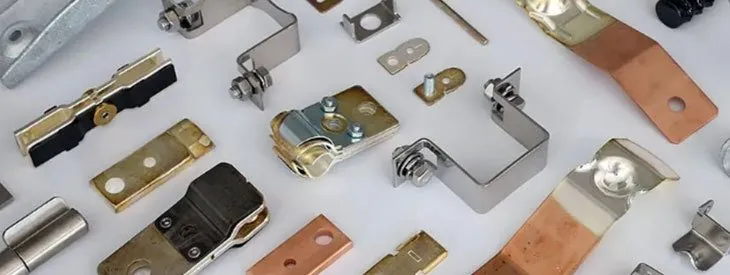
The choice of material for cold stamping will depend on a number of factors, including the shape of the part, the desired strength and finish of the part, and the environmental conditions that the part will be exposed to.
Stamping is a forming process that relies on presses and moulds to apply external forces to plates, strips, tubes and profiles to produce plastic deformation or separation, so as to obtain workpieces of the required shapes and sizes, including punching, bending, deep drawing, forming, finishing and other processes. Stamping process and mould, stamping equipment and stamping materials constitute the three elements of stamping processing, only they can be combined with each other to produce stamped parts. Precision hardware stamping parts can be divided into many types according to the industry, use and process characteristics.
What are the precision hardware stampings
- Automobile parts: it mainly contains automobile structural parts, automobile functional parts, automobile lathe parts, automobile relays and so on.
- Electronic parts: It mainly contains connecting devices, connectors, brushes, electrical terminals, elastic parts, etc.
- home appliance parts: mainly contains large appliances parts, such as colour tube electronic gun parts, as well as small home appliance parts, various types of structural and functional parts.
- IC integrated circuit lead frame: mainly contains discrete device lead frame and integrated circuit lead frame.
- motor core: mainly contains single-phase series-excited motor core, single-phase household motor core, single-phase shaded-pole motor core, permanent magnet DC motor core, industrial motor core, plastic stator core and so on.
- electrical appliances iron core: mainly contains E-shaped transformer core, EI-shaped transformer core, I-shaped transformer core, and other transformer iron chip.
- heat exchanger fins: mainly contains industrial heat exchanger fins, household heat exchanger fins, automotive heat exchanger fins and so on.
- other parts: mainly contains instrument parts, IT parts, acoustic and camera parts, modern office parts, and daily-use hardware.
Advantages of Precision Stamping
- high productivity of stamping, and easy to operate, easy to achieve mechanisation and automation. This is because the stamping is relying on the punch mould and stamping equipment to complete the processing, the number of ordinary press strokes per minute up to dozens of times, high-speed pressure per minute up to hundreds or even more than a thousand times, and each stamping stroke may be a punch.
- stamping due to the mould to ensure that the size and shape of the stamped parts of the precision, and generally do not destroy the surface quality of the stamped parts, and the life of the mould is generally longer, so the quality of the stamping is stable, interchangeability is good, with the ‘one and the same’ characteristics.
- stamping can be processed out of a larger size range, the shape of the more complex parts, such as small to the stopwatch, large automobile longitudinal beams, cover parts, etc., coupled with the cold deformation of the material hardening effect of stamping, stamping of the strength and stiffness are higher.
- stamping generally no chips and debris generation, less material consumption, and do not need other heating equipment, so it is a kind of material saving, energy-saving processing methods, stamping parts of the lower cost.
Precision Stamping Process Issues
Hardware stamping common problems include: precision stamping parts of the deformation, burr, etc.; bending parts of the crack, warping, surface abrasion, corner deformation, etc.; deep drawing parts of the flange wrinkles, deep drawing wall wrinkles, deep drawing wall damage, cracking, etc.; edge cracks, uneven expansion, etc.
Solutions to common problems: mould design should have a reasonable value of the gap between the convex and concave die, corner radius and processing accuracy. When designing the bending mould, take effective measures to reduce the rebound and subtract the amount of rebound on the mould; design reasonable rounded corners to prevent bending cracks. Deep drawing with crimping ring to prevent wrinkles, and the pressure should be moderate; with appropriate lubrication to reduce the resistance to deep drawing, in order to prevent the mould from sticking or make the workpiece pull through; the use of professional stamping oil in line with the requirements of the process.
Leave a Comment