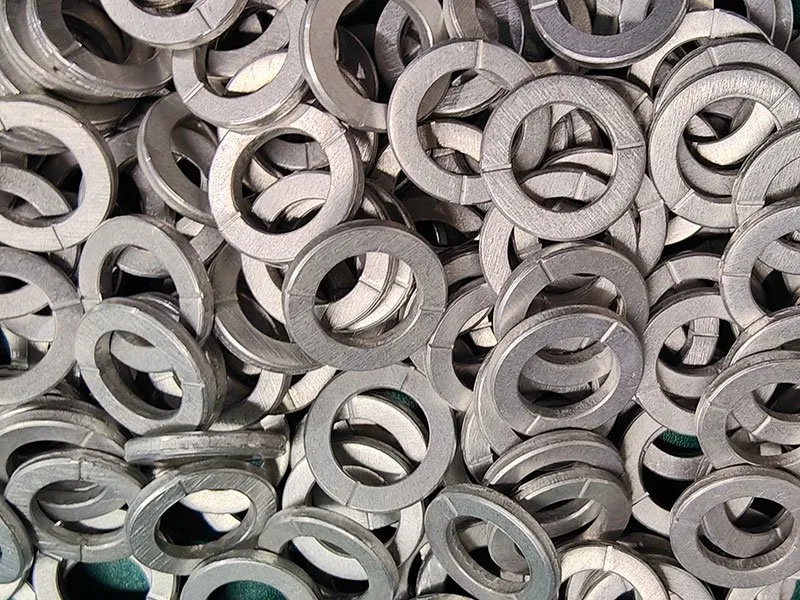
Cold stamping process and tooling design document for double-sided chamfered round washer.
I. Process requirement analysis
1.Product Overview
Double-sided chamfered round washers, as crucial components in mechanical connections, are extensively utilized in various types of mechanical equipment. They serve to increase contact area, reduce friction, disperse pressure, and prevent leakage. Their distinctive feature lies in their precise diameter, thickness, and double-sided uniform chamfering that meets the required standards, ensuring the tightness and stability of the assembly.
2.Key parameters and requirements
♦ Diameter and thickness: Depending on the specific application scenario, it is necessary to precisely control the diameter and thickness of the washer to meet the assembly requirements.
♦ Double-sided chamfering: The chamfer size (e.g. 0.15mm) needs to be uniform to reduce stress concentration during assembly and improve sealing performance.
♦ Parallelism requirement: The parallelism of both sides of the washer directly affects the flatness after assembly, and it needs to be strictly controlled within the allowable range to ensure the smooth operation of the equipment.
♦ Material selection: Select appropriate materials such as stainless steel, copper alloy, etc. based on the working environment (such as temperature, pressure, medium, etc.) to meet performance requirements such as corrosion resistance and high temperature resistance.
II. Process scheme design
1.Determination of process flow: raw material inspection → cutting and blanking → punching → double-sided chamfering → deburring → cleaning → inspection → packaging.
2.Selection of chamfering processing method: Cold stamping combined with specialized toolings is used to achieve simultaneous or step-by-step chamfering on both sides, ensuring processing efficiency and accuracy.
3.Setting of quality control points: Quality control points are established in key processes such as cutting, punching, and chamfering, and strict quality inspection is implemented.
III. tooling Structure Design
1.Overall layout of the tooling: Design the upper and lower tooling structures. The upper tooling includes the pressure plate, punch, and chamfering edge, while the lower tooling is equipped with a concave tooling and positioning device.
2.Chamfering blade design: Design precise blade angles and shapes based on the chamfering size (0.15mm), ensuring uniform chamfering on both sides.
3.Positioning and Guidance System: Utilizing a high-precision guide column and guide sleeve system to ensure tooling clamping accuracy and repeated positioning accuracy.
4.Unloading and Ejection Mechanism: Design a reasonable unloading plate and ejection device to ensure smooth detoolinging of the finished product and avoid deformation.
IV. Materials and Processing Technology
5.tooling material: High-hardness, wear-resistant, and high-toughness tooling steel, such as Cr12MoV or SKD11, is selected to ensure the service life and processing accuracy of the tooling.
6.Heat treatment: Conduct quenching, tempering, and other heat treatments on key components of the tooling to enhance hardness and wear resistance.
7.Processing technology: High-precision CNC machining centers are used for tooling processing to ensure the dimensional accuracy and surface quality of all tooling components.
V. tooling debugging and optimization
1.No-load tooling testing: Conduct no-load tooling testing without any material to check the fit of various components and adjust them to their optimal state.
2.Trial toolinging with materials: Gradually increase the punching pressure, observe the toolinging effect of the washer, adjust parameters such as tooling clearance and blade angle, until the product requirements are met.
3.Continuous optimization: Based on the results of tooling testing and production feedback, continuously optimize the tooling structure and process parameters to improve production efficiency and product quality.
VI.Production Implementation and Monitoring
1.Formulation of production plan: Based on market demand and production capacity, a detailed production plan is formulated to ensure the timely and quantitative completion of production tasks.
2.Production process monitoring: Implementing full-process monitoring, including raw material inspection, equipment status inspection, process parameter recording, finished product quality inspection, etc., to ensure that each step meets the requirements.
3.Quality Control and Traceability: Establish a comprehensive quality management system, conduct full or spot checks on finished products, and record information such as production batches and inspection results to achieve quality traceability.
4.Continuous improvement: Regularly collect production data and user feedback, analyze existing problems and shortcomings, develop improvement measures, and continuously enhance production efficiency and product quality.
Leave a Comment