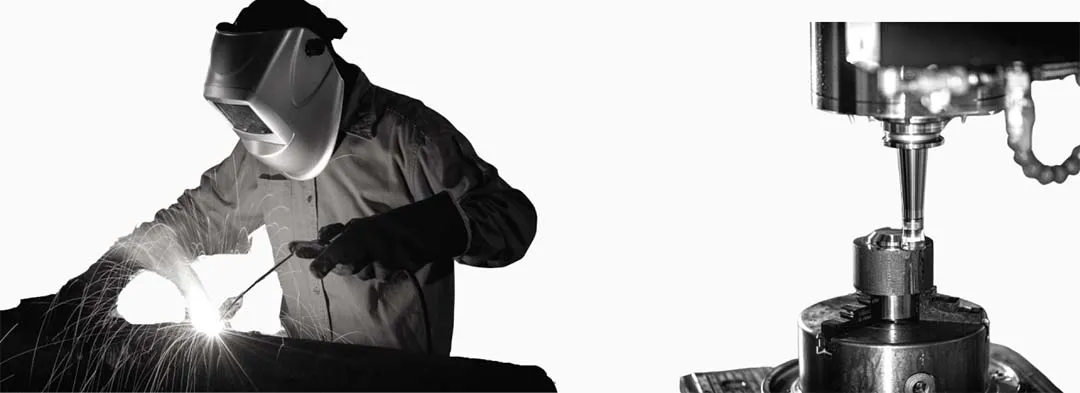
In this article, we will introduce the mainstream 25 metal processing methods. These methods are widely used in the manufacturing process of metalworking.
What is metalworking
Metalworking is the production activity that involves applying various processes to metallic materials in order to create required parts, components, or large structures. It encompasses a wide range of projects, from oil rigs, ships, and bridges to small engine parts and jewelry. To achieve the desired results, metal processing requires the use of a diverse range of techniques, processes, and tools.
What are the methods
The process of metal processing is generally categorized into three main categories: metal forming, metal cutting, and metal joining. These categories encompass a range of techniques utilized to shape, cut, and join metal materials.
Metal forming techniques, such as forging, rolling, and extrusion, are employed to alter the shape and structure of the metal. Metal cutting processes, including machining, drilling, and sawing, are utilized to remove material and achieve the desired shape. Metal joining methods, such as welding, soldering, and brazing, are employed to fuse separate metal pieces together, creating a unified structure. These three categories play pivotal roles in the fabrication and manufacturing of metal components and structures.
1. Die casting
Die casting (note that die casting is not an abbreviation for pressure casting) is a metal casting process characterized by the application of high pressure to molten metal within a mold cavity. The molds used in die casting are typically machined from stronger alloys, which is a process somewhat similar to injection molding.
2. Sand casting
Sand casting involves the use of sand to create molds. The process begins by placing a finished part model or a wooden model (pattern) into the sand. The pattern is then covered with sand, compacted, and left to set over a period of time. To facilitate the removal of the model before pouring the metal, the mold is typically made in two or more parts. During the mold-making process, specific holes and vent holes are created to establish the pouring system for the metal. Once the molten metal is poured into the mold, the mold is left undisturbed until the metal solidifies. After the parts are removed, the molds are typically destroyed, requiring the creation of a new mold for each casting.
3. Investment casting
Investment casting, also known as lost wax casting, involves a series of processes including wax pressing, wax repairing, tree grouping, dipping, wax melting, molten metal casting, and post-processing. In lost wax casting, a wax mold of the desired part is created using wax. The wax mold is then coated with a ceramic or mud material, forming a ceramic mold. Once the ceramic mold is dried, it undergoes a firing process to transform it into a pottery mold. During this firing process, all the wax is melted and lost, leaving behind only the pottery mold. Typically, a pouring port is created in the mud mold, through which the molten metal is poured. After the metal cools and solidifies, the desired parts are obtained.
4. Die forging
Die forging is a forging method that utilizes a die and specialized die forging equipment to shape a blank and obtain a forged product. Depending on the equipment used, die forging can be categorized into various types, including hammer die forging, crank press die forging, flat forging machine die forging, friction press die forging, and more.
Roll forging, on the other hand, is a plastic forming process where the material undergoes plastic deformation by a pair of counter-rotating dies to produce the desired forging or forging blank. It is a specific form of longitudinal rolling and is commonly employed in the manufacturing industry.
5. Forging
Forging is a metal processing method that involves applying pressure to a metal blank using a forging machine in order to plastically deform it and produce a forging with specific mechanical properties, shape, and size. It is one of the two primary components of the forging process, alongside stamping.
Forging offers several advantages. It helps eliminate defects such as as-cast looseness that may occur during the metal smelting process and allows for the optimization of the microstructure. Additionally, due to the preservation of the metal’s complete grain structure, forgings generally exhibit superior mechanical properties compared to castings of the same material. In machinery applications where high loads and severe working conditions are involved, forgings are commonly preferred over rolled plates, profiles, or welded parts with simpler shapes.
6. Rolling
Rolling, also known as calendering, is a metal processing technique that involves passing a metal ingot through a pair of rollers to shape it. Depending on the temperature of the metal during the process, rolling can be classified as either “hot rolling” or “cold rolling.” Hot rolling occurs when the metal’s temperature exceeds its recrystallization temperature, while cold rolling takes place when the metal is below its recrystallization temperature. Calendering is widely used in metal processing and is considered the most common method.
Die casting, on the other hand, involves the rapid injection of liquid or semi-liquid metal into a die-casting mold under high pressure. The metal fills the cavity of the mold and solidifies under pressure, resulting in the formation of a casting. Die casting is an efficient method for producing complex and precise metal parts.
7. Low pressure casting
Low-pressure casting is a casting method in which liquid metal is introduced into a mold and solidifies into a casting under the influence of low-pressure gas. Initially, low-pressure casting was primarily utilized for producing aluminum alloy castings. However, its application has expanded to include the production of copper castings, iron castings, and even steel castings with higher melting points. This method offers advantages such as improved casting quality, reduced porosity, and better dimensional accuracy. Low-pressure casting is widely employed in various industries for manufacturing high-quality metal castings.
8. Centrifugal casting
Centrifugal casting is a technique used to produce castings by injecting liquid metal into a rapidly rotating mold. The molten metal fills the mold and takes the shape of the mold due to the centrifugal force acting upon it. The choice of mold in centrifugal casting depends on factors such as the shape, size, and production volume of the casting. Non-metallic molds like sand molds, shell molds, or investment shell molds can be used, as well as metal molds with a coating layer or a resin sand layer for specific casting requirements. Centrifugal casting allows for the production of high-quality castings with improved density and reduced porosity.
9. Lost foam casting
Lost foam casting is a casting method that involves bonding and assembling paraffin or foam models, which are similar in size and shape to the desired castings, into clusters. After applying a refractory paint and allowing it to dry, the clusters are placed in dry quartz sand for vibration modeling. The molten metal is then poured under negative pressure, causing the model to vaporize. The liquid metal fills the void left by the vaporized model, solidifies, and cools to form the final casting.
Lost foam casting is a precise and nearly margin-free process. It eliminates the need for mold removal, eliminates the presence of parting surfaces and sand cores, and results in castings without flash, burrs, or draft angles. This process also reduces dimensional errors caused by core misalignment due to core loss.
10. Squeeze casting
Squeeze casting, also known as liquid die forging, is a casting process in which molten metal or semi-solid alloy is directly injected into an open mold. The mold is then closed, creating a filling flow that conforms to the outer shape of the part. High pressure is applied to the solidified metal (shell), causing plastic deformation. Simultaneously, the unsolidified metal undergoes isostatic pressing and high-pressure solidification. This process ultimately results in the production of a finished product or blank.
In direct squeeze casting, the molten metal is injected into the open mold cavity. In indirect squeeze casting, a solid alloy is injected into a closed mold cavity through a punch. High pressure is then applied to induce crystallization and solidification under pressure, leading to the formation of the desired product or blank. Squeeze casting combines the advantages of both casting and forging processes, resulting in improved mechanical properties and dimensional accuracy of the castings.
11. Continuous casting
Continuous casting is a casting method that involves the continuous pouring of liquid metal into a through mold. The mold is designed with a specific shape and size to produce the desired cross-sectional profile of the casting. As the liquid metal is poured into one end of the mold, it solidifies gradually along the length of the mold.
Simultaneously, the solidified metal is continuously withdrawn or pulled out from the other end of the mold. This process allows for the continuous production of long metal shapes, such as bars, billets, slabs, or even pipes, without the need for individual mold cavities for each casting.
Continuous casting offers several advantages over traditional batch casting methods. It enables higher production rates, improved yield, and cost efficiency. The resulting castings often have better internal quality, reduced porosity, and improved surface finish. Continuous casting is widely used in the manufacturing of steel, aluminum, copper, and other metal products.
12. Drawing
Drawing is a plastic processing method that involves applying an external force to the front end of a metal blank, pulling it through a die hole that is smaller than the cross-sectional area of the blank. This process results in the formation of a product with the corresponding shape and size. Drawing is often performed at room temperature or in a cold state, earning it the names “cold drawing” or “cold working.”
During the drawing process, the metal blank undergoes plastic deformation, which elongates and thins it. This process is commonly used to create wire, tubes, rods, and other elongated metal products with precise dimensions and improved mechanical properties. Cold drawing offers benefits such as improved surface finish, increased strength, and enhanced dimensional accuracy. It is widely employed in industries such as manufacturing, construction, automotive, and aerospace.
13. Stamping
Stamping is a metal forming and processing method that involves the application of external force to sheets, strips, pipes, or profiles using presses and dies. This force causes plastic deformation or separation of the material, resulting in the production of workpieces known as stamping parts.
The process of stamping typically involves placing the metal material between a die and a punch. The punch applies force to the material, causing it to undergo deformation and take the shape of the die cavity. Stamping can be used to create a wide range of shapes and sizes, including complex geometries.
Stamping is commonly used in various industries, such as automotive, aerospace, electronics, and appliances, to manufacture components and parts with high precision and efficiency. It offers advantages such as rapid production, cost-effectiveness, and the ability to create parts with consistent quality.
14. Metal Injection Molding (MIM)
Metal Injection Molding (MIM) is a near-net forming technology that combines principles from both powder metallurgy and plastic injection molding. It originated from the plastic injection molding industry, which is known for producing complex shapes at a low cost. However, plastic products lack the strength required for certain applications. To enhance the strength and wear resistance, metal or ceramic powders can be added to the plastic material.
In MIM, the process involves mixing fine metal powders with a thermoplastic binder to create a feedstock. The feedstock is then injected into a mold cavity under high pressure, similar to plastic injection molding. After injection, the part is cooled and ejected from the mold, resulting in a “green” part.
The next step involves removing the binder from the green part through a debinding process, typically using thermal or solvent methods. The debound part is then sintered at high temperatures to fuse the metal powders together, resulting in a dense and solid metal component.
MIM allows for the production of intricate and highly detailed parts with excellent dimensional accuracy. It offers advantages such as near-net shape production, the ability to incorporate complex geometries, and the potential for cost savings compared to traditional machining methods. MIM is widely used in industries such as automotive, aerospace, medical, and electronics for the production of small to medium-sized metal components.
15. Turning
Turning is a fundamental part of mechanical processing and is commonly performed on a lathe machine. In lathe machining, turning tools are used to shape the rotating workpiece. Lathes are primarily employed for processing workpieces with cylindrical, disc-like, or sleeve-like shapes that possess rotating surfaces. They are the most widely utilized machine tools in machinery manufacturing and repair facilities.
Turning involves cutting a workpiece on a lathe by utilizing the relative rotation between the workpiece and the cutting tool. The cutting energy in turning primarily comes from the workpiece itself rather than the tool. Turning is the most fundamental and prevalent cutting method, playing a crucial role in production processes. It is particularly suitable for machining rotary surfaces. Most workpieces with rotational surfaces can be effectively processed using turning methods, including inner and outer cylindrical surfaces, inner and outer conical surfaces, end faces, grooves, threads, and rotary forming surfaces. The primary tools utilized in turning are turning tools.
16. Milling
Milling is a machining process that involves securing the workpiece and utilizing a high-speed rotating milling cutter to remove material and create the desired shapes and features. Conventional milling is commonly used for simpler shapes and features like contours and slots. However, CNC (Computer Numerical Control) milling machines are capable of processing complex shapes and features.
CNC milling machines provide advanced capabilities for milling operations. They can perform three-axis or multi-axis milling and boring processes, making them suitable for machining tasks such as molds, inspection tools, tire molds, intricate surfaces, artificial prostheses, and blades. CNC milling machines offer precise control and automation, allowing for efficient and accurate production.
When selecting CNC milling as a machining method, it is important to leverage the advantages and key functions of CNC milling machines. These machines provide flexibility, accuracy, and the ability to handle complex geometries. By utilizing the capabilities of CNC milling machines, manufacturers can achieve superior results and optimize their production processes.
17. Planing
Planing is a cutting method commonly used for shaping parts. It involves the use of a planer, which moves in a horizontal linear reciprocating motion across the workpiece. Planing is primarily employed to achieve specific shapes and dimensions during the machining process.
Planing processing typically offers a precision range of IT9 to IT7, indicating the level of dimensional accuracy achieved. The surface roughness, measured by the parameter Ra, falls within the range of 6.3 to 1.6 micrometers (um). The Ra value describes the average roughness of the machined surface, with lower values indicating a smoother surface finish.
Planing is commonly used in various industries, especially for machining large workpieces or achieving flat surfaces with specific dimensions and surface finishes. It is important to consider the desired precision and surface roughness requirements when selecting planing as a machining method.
18. Grinding
Grinding is a widely used machining method that involves the removal of excess material from a workpiece using abrasive particles and abrasive tools. It is primarily employed to achieve precise dimensions, improve surface finish, and enhance the accuracy of the final product.
During the grinding process, abrasive particles, typically in the form of grains or wheels, are applied to the workpiece surface with controlled pressure and relative motion. These abrasive particles remove small chips of material through cutting, plowing, and rubbing actions, resulting in the desired shape, dimension, and surface quality.
Grinding can be performed on a variety of materials, including metals, ceramics, composites, and even some non-metallic materials. It is used in various industries such as automotive, aerospace, tooling, and precision manufacturing.
The advantages of grinding include its ability to achieve high precision, tight tolerances, and excellent surface finishes. It is commonly utilized for applications that require fine surface quality, such as bearing races, gears, precision tools, and components with intricate shapes or critical dimensions.
19. Selective Laser Melting (SLM)
Selective Laser Melting (SLM) is indeed a metal processing method that utilizes a high-power carbon dioxide laser and metal powder to create solid metal parts. The process involves a tank or build chamber filled with metal powder, typically a fine and consistent particle size.
In SLM, a computer-controlled laser scans and selectively melts the metal powder in a layer-by-layer fashion. The laser beam is directed to specific areas determined by a digital model or CAD file. Wherever the laser passes, the intense heat causes the metal powder particles to melt and fuse together, forming a solidified layer. The process is repeated, adding subsequent layers of melted and fused metal, until the desired part is fully formed.
SLM is an additive manufacturing technology, often categorized as a form of 3D printing. It allows for the creation of complex geometries and precise structures that would be challenging or impossible to achieve using traditional manufacturing methods. SLM is commonly used in industries such as aerospace, medical, and automotive for producing high-quality, custom metal parts with excellent mechanical properties.
20. Surface
The surface is completely melted and bonded together, while the non-illuminated areas remain in a powdery state. The entire process needs to be conducted within a sealed chamber filled with inert gas.
21. Selective laser sintering
Selective Laser Sintering (SLS) is a method that utilizes infrared lasers as the energy source, and it predominantly employs powder materials as the modeling materials. During the SLS process, the powder is initially preheated to a temperature slightly below its melting point. Subsequently, under the action of a leveling stick, the powder is flattened.
The laser beam selectively sinters the powder based on the layered section information, which is controlled by a computer. This process completes one layer. The subsequent layers are then sintered, and once all the sintering is finished, the excess powder is removed, resulting in a sintered part.
Currently, the SLS process primarily employs mature materials such as wax powder and plastic powder. However, the application of metal powder or ceramic powder in the sintering process is still being studied.
22. Metal deposition Somewhat
Metal deposition, also known as metal powder deposition or metal powder spraying, is a manufacturing process that shares similarities with fused deposition modeling (FDM) but involves the use of metal powder instead. In this process, metal powder materials are sprayed through a nozzle while simultaneously providing high-power laser and inert gas protection.
Unlike traditional methods that rely on the size of the metal powder box, metal deposition allows for the direct manufacturing of larger-volume parts. It is particularly well-suited for repairing partially damaged precision parts, as it enables precise deposition of metal material onto specific areas.
During the metal deposition process, the metal powder is sprayed onto the target surface, and the high-power laser melts and fuses the powder particles, bonding them to the substrate. The inert gas protection helps create a controlled environment, preventing oxidation and ensuring the quality of the deposited metal.
Metal deposition has found applications in various industries, including aerospace, automotive, and tooling, where it offers the advantage of on-demand fabrication and repair of metal components with complex geometries and precise specifications.
23. Roll Forming Roll forming
Roll forming is the process of using a series of continuous stands to roll stainless steel into complex shapes. The sequence of rolls is designed in such a way that each stand’s roll profile continuously deforms the metal until the desired final shape is achieved. For complex-shaped parts, up to thirty-six racks can be utilized, while three or four racks are sufficient for parts with simpler shapes.
24. Die forging
Die forging is a forging method that involves using a die on specialized die forging equipment to shape a blank and obtain a forged product. This method produces forgings that are precise in size, require minimal machining allowance, possess complex structures, and exhibit high productivity.
25. Die-cutting
Die-cutting is a blanking process that involves positioning the film, which was formed in the preceding process, onto the male die of the punching die. By closing the die, the excess material is removed, while the 3D shape of the product is retained, ensuring a match with the mold cavity.
In the die-cutting process, the film panel or circuit is positioned on the bottom plate, while the die is fixed on the upper template of the machine. The downward pressure exerted by the machine is utilized to control the blade and cut the material. Unlike the punching die, die cutting produces smoother incisions. Additionally, by adjusting the cutting pressure and depth, effects such as indentation and half-break can be achieved. Moreover, die cutting offers the advantages of cost-effective mold operation, convenience, safety, and speed.
Leave a Comment