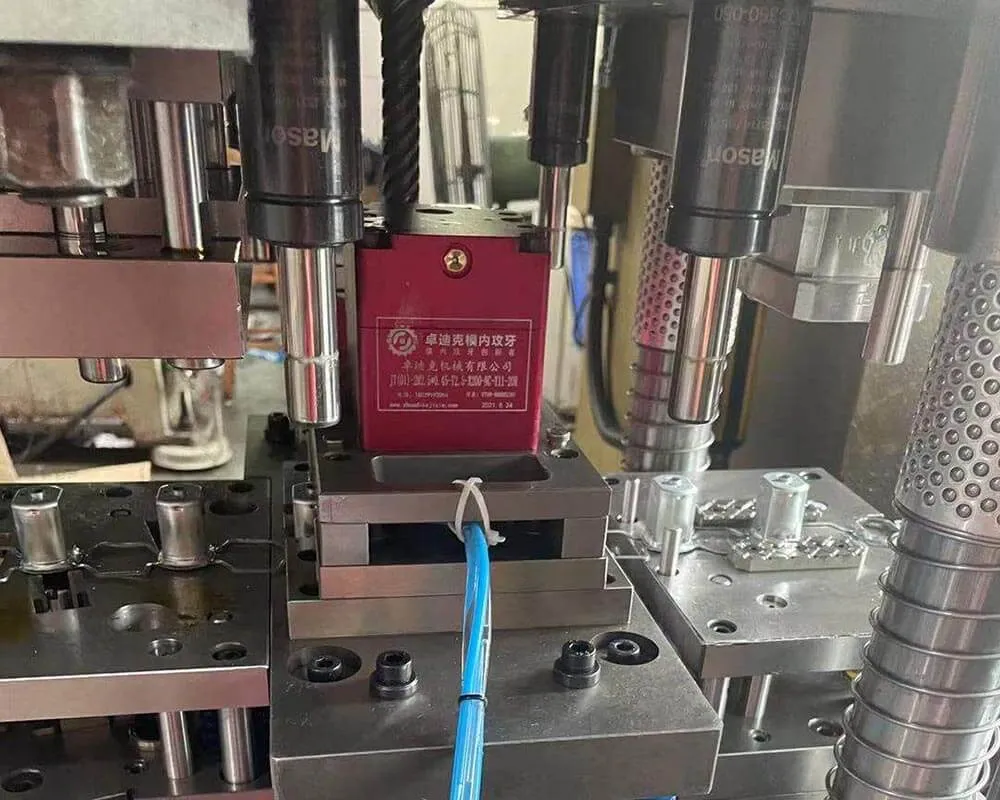
Balford has always aimed to optimize manufacturing processes with the goal of improving efficiency and reducing costs, which serves as the core competitive advantage of our factory. To achieve this, we have introduced the “In-Die Tapping” technology, which plays a crucial role in the field of progressive die stamping.
In traditional manufacturing processes, the stamping and threading operations for parts with threaded holes are typically carried out separately, leading to increased production complexity and reduced efficiency. By integrating In-Die Tapping units into the progressive die stamping process, threading is directly incorporated into the die.
This technique cleverly merges traditional threading processes with stamping operations, achieving efficient, high-precision, and automated production. By streamlining the production process and reducing the need for secondary operations, we have significantly enhanced production efficiency and product quality.
We are continuously dedicated to innovation, providing customers with competitive and sustainable solutions. We actively adopt various processing technologies that enhance efficiency, continually optimizing our manufacturing processes. Through team enhancements and technology integration, we have fulfilled our commitment to sustainable practices.
in-die tapping FAQ
The in-die tapping unit is a specialized equipment used to assist in generating threads during stamping forming. It combines traditional stamping and tapping techniques by converting the up-and-down movement of the press slide into the spiral motion of an extrusion tap for thread formation.
In-die tapping technology is suitable for continuous die sets, progressive die sets, and precision die sets, achieving chipless processing, avoiding secondary operations, improving production efficiency and cleanliness, and enhancing thread strength. The working principle of the in-die tapping machine involves the reciprocating motion of the press slide to complete various functions such as feeding, positioning, material punching, and bending to achieve thread forming. This technology is applicable to various thread hole processing, including blind holes, with wide adaptability, and can significantly enhance production efficiency and product quality in metal parts manufacturing. It is frequently employed in the sheet metal stamping industry for threading materials like aluminum, brass, and stainless steel.
Leave a Comment