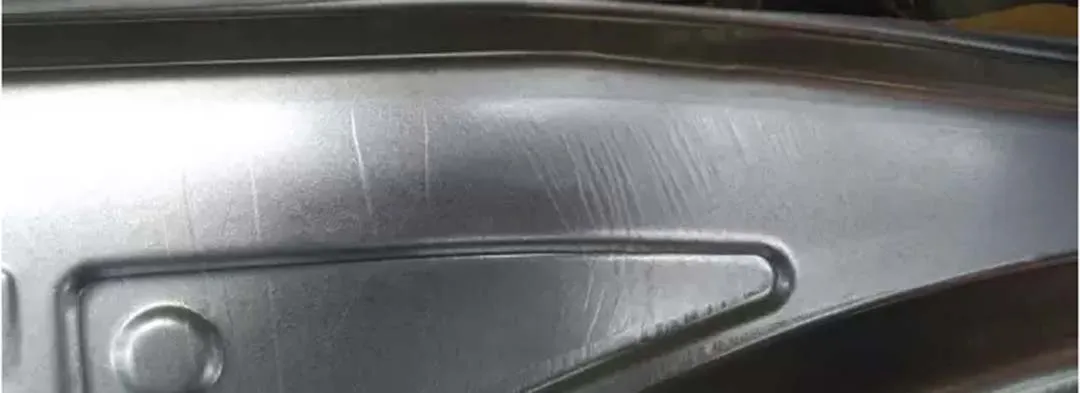
During the stretch stamping process, the punch presses the sheet metal blank into the die cavity to form a contoured part. A part is called stretch if its depth is at least half its diameter. Otherwise, it is simply called universal stamping.
Close-up of unwrinkled sheet metal
Draw stamping is a widely used process that produces a range of hardware parts, and the deep drawing process may have one or more drawing operations, depending on the complexity of the part.
Creping and stretching stamping process
One of the main defects that occurs in deep drawing operations is wrinkling of sheet metal material, usually in the walls or flanges of the part. During the stamping process, the blank flange is subjected to radial pulling stress and tangential compressive stress, and sometimes wrinkles are generated. Wrinkling can be prevented if the stretching system and stampings are designed properly.
There are several factors that cause wrinkles in deep-drawn parts, including:
- Blank support pressure
- Cavity depth and radius
- Friction between blank, blank holder, punch and cavity
- Gap between blank, blank holder, punch and cavity
- Blank shape and thickness
- Final Part Geometry
- Punch speed
Other factors, such as die temperature and the metal alloy of the blank, can also affect the drawing process. Variations in any of these factors can affect the likelihood of wrinkling or cracking in deep drawn parts.
As the name suggests, the blank holder holds the edge of the sheet metal blank in place on the top of the die, while the punch forces the sheet metal into the die cavity – the sheet metal deforms into the correct shape, rather than simply being pulled into the die cavity.
However, the blank holder will not hold the edge of the blank securely in place, and if this is the case, the wall of the cup may tear. The blank holder allows the blank to slide to some extent by providing friction between the blank holder and the blank itself. Blank support force can be applied hydraulically through pressure feedback by using air or nitrogen pads or CNC hydraulic buffers.
The greater the cavity depth, the more blank material must be pulled into the cavity, and the greater the risk of wrinkling in the part walls and flanges. The maximum cavity depth is a balance between wrinkling and fracture initiation, neither of which is desirable.
The radii of the punch and cavity edges control the flow of blank material into the cavity. Cup wall wrinkling may occur if the radius of the punch and cavity edge is too large. If the radius is too small, the blank is prone to tearing due to high stress.
The method to prevent the wrinkling of deep-drawn parts: use the blank support
The easiest way to eliminate wrinkling in deep-drawn parts is to use a blank holder. In most deep drawing processes, a constant blank holder pressure is applied throughout the drawing process.
However, there has been some success with the use of variable blank holder pressure, pneumatic or hydraulic blank holder pads that can vary the blank holder pressure linearly depending on the stroke of the machine. This provides some increase in the allowable cavity depth.
Numerically controlled (NC) die pads can be used to provide variable blank holder pressure during the drawing operation, with a larger initial force in a suitable blank holder pressure force profile to provide initial deformation.
Cushion pads come off to pull material into the cavity, then slowly increase pick-up to ensure strain hardening in stretched parts, NC die pads can significantly increase the allowable cavity depth while preventing wrinkling and cracking.
Methods to prevent wrinkling of deep-drawn parts: cavity design
The punch and cavity design can be optimized to reduce the probability of wrinkling. Choosing a flange radius just large enough to prevent cracking minimizes the possibility of wrinkles. Also, it can be helpful to consider minimizing part complexity and any asymmetries. Using a multi-step drawing process offers several advantages in preventing wrinkling in deep-drawn parts.
Designing the blank geometry to minimize excess material can reduce the possibility of wrinkling. Sheet metal blanks have an inherent grain structure, so stress can vary depending on the design of the mold and the orientation of the grains. The general stress of compounding and deep drawing processes to tune the grain in an asymmetric design to minimize grain stress is a consideration.
Other factors to consider
Excessive compressive stress, thin material, poor lubrication, inadequate blank holding, sharp die design, and challenging material properties can lead to wrinkling in the drawing process. Controlling these factors prevents wrinkles and ensures successful drawing.
Specific methods to prevent wrinkling
- Surface Prep: Begin with a secured and smooth surface, such as properly stretched paper, to minimize the risk of wrinkling.
- Use Quality Materials: Ensure you are using good-quality materials that are less prone to wrinkling, such as sturdy paper or suitable drawing surfaces.
- Control Humidity: Maintain a steady humidity level in your workspace to avoid excess moisture absorption by the paper, which can contribute to wrinkling.
- Layering Technique: Apply media in thin layers, allowing each layer to dry before adding more. This gradual buildup helps prevent excessive moisture and reduces the chances of wrinkling.
- Support Below: Place a firm surface, such as a drawing board, under your drawing area to provide even support and minimize the risk of wrinkling.
- Apply Gentle Pressure: Use a light touch when applying pressure with your drawing tools to avoid excessive pressure that could lead to buckling and wrinkling.
- Take Your Time: Avoid rushing the drawing process, as quick and hasty movements can increase the likelihood of wrinkling. Take your time and work methodically.
- Erase Carefully: Be gentle when erasing, as aggressive erasing can damage the paper and potentially cause wrinkling.
- Consider Fixative Spray: For dry media, you may consider using a fixative spray between layers. This can help stabilize the drawing and reduce the risk of wrinkling.
- Research Techniques: Learn professional tips and techniques specific to your preferred medium to minimize the occurrence of wrinkling and achieve the best results.
Specific methods To prevent tearing
- Material Selection: Choose materials with good ductility and stretchability to withstand deformation without tearing. Consider using materials specifically designed for deep drawing applications.
- Proper Lubrication: Apply an appropriate lubricant between the sheet metal and the die surfaces to reduce friction and facilitate smooth material flow. Adequate lubrication minimizes the risk of tearing.
- Die Design: Design the die with rounded corners and radii to distribute stress more evenly and avoid sharp angles that could promote tearing. A well-designed die minimizes stress concentrations.
- Blank Holding Force: Ensure uniform and sufficient blank holding force during the drawing process. Proper blank holding prevents material from lifting or tearing at the edges.
- Slow Drawing Speed: Control the drawing speed to allow the material to flow gradually and evenly. High speeds can lead to rapid deformation and tearing.
- Optimal Clearance: Set the proper clearance between the punch and die to prevent excessive thinning and material stress that could lead to tearing.
- Die Radii Ratio: Maintain a proper ratio between the punch and die radii. An appropriate ratio reduces localized stress concentrations and minimizes the risk of tearing.
- Blank Shape: Use a blank shape that minimizes stretching and avoids sudden changes in curvature, reducing the likelihood of tearing.
- Warm Forming: Consider performing the deep drawing process at an elevated temperature, which can increase material ductility and decrease the risk of tearing.
- Trimming: After the drawing process, trim excess material carefully to avoid inducing stress concentrations or sharp edges that could lead to tearing during subsequent handling or use.
- Quality Control: Regularly inspect the drawn parts for signs of tearing or other defects during the process. Catching issues early allows adjustments to be made to prevent further problems.
Leave a Comment