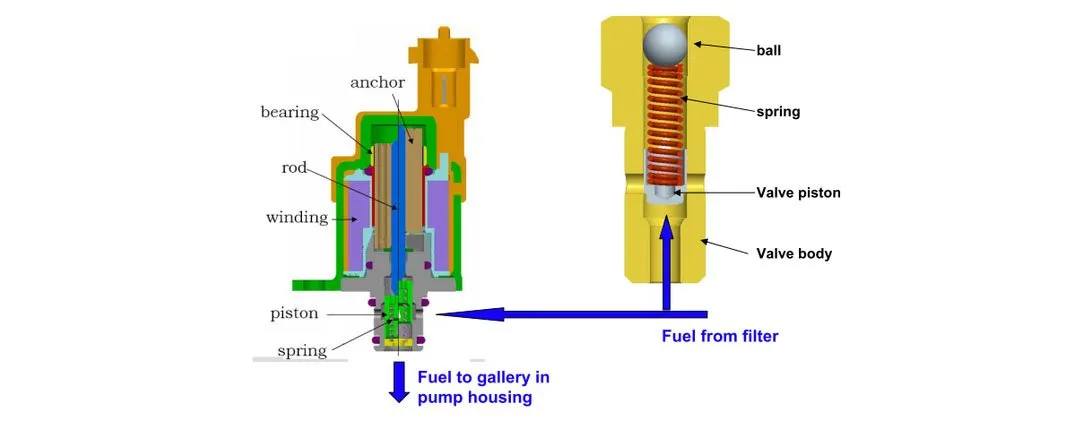
The fuel metering unit valve, also known as the metering proportional valve, is installed at the fuel inlet position of the high-pressure fuel pump and is responsible for regulating fuel supply and pressure. When this valve encounters issues, it is crucial to address the failure and implement appropriate treatment methods to restore optimal functionality.
The fuel metering unit valve is controlled by the ECU and is generally applicable to Yuchai National 3 and National 4 series electronically controlled diesel engines that support the BOSCH high-pressure common rail fuel injection system.
The structural principle of the metering valve is quite simple. The fuel metering valve and the overflow valve are the two key components with a relatively high failure rate in the Bosch common rail high-pressure fuel pump. In most cases, the fault location and type can be accurately identified, and the fuel metering valve and overflow valve components can be separately inspected, cleaned, or replaced, thus avoiding unnecessary replacement of the entire pump.
The fuel metering valve is a proportional solenoid valve usually installed at the fuel inlet position of the high-pressure fuel pump. It is controlled by the PWM signal output by the ECU. The ECU controls the opening of the fuel metering valve by changing the duty cycle of the PWM signal, thereby controlling the amount of fuel entering the plunger and regulating the common rail pressure. The top dead center diagnostic instrument has all the necessary functions.
Different models of Yuchai Bosch common rail electronically controlled diesel engines may have slight variations in the structure, characteristics, installation position, and electrical interface of the fuel metering valve, depending on the applied high-pressure fuel pump model and specific control strategy. When replacing, it is important to pay attention to these differences, especially the default state characteristics (in the case of power failure). The fuel metering valve can be categorized into two types: normally open and normally closed. In practical applications, it can be determined by the presence of a pressure relief valve on the common rail pipe. Generally, commercial vehicle platform engine common rail pipes have a pressure relief valve, and their fuel metering valve is normally open. On the other hand, passenger vehicle platform engine common rail pipes do not have a pressure relief valve, and their fuel metering valve is normally closed. The top dead center diagnostic instrument has all the necessary functions.
In the case of a normally open fuel metering valve, the default working state is open, and the flow is maximum when not energized. Conversely, the current characteristics of the normally closed type are the opposite. The overflow valve is a multi-stage mechanical valve used to adjust the oil delivery pressure of the oil pump. It is crucial for ensuring the normal lubrication and oil return of the oil pump. When the oil pressure at the fuel metering valve inlet is too high (usually 0.1 MPa), the overflow valve will open the oil return port, allowing the fuel to return to the inlet of the input pump or the fuel tank.
Different models may have slightly different fault phenomena and fault code definitions depending on the type of fuel metering valve used and specific control strategies. However, the basic troubleshooting ideas remain the same.
Common Failure Modes of Fuel Metering Valves
There are several common failure modes of fuel metering valves, which can be identified through various symptoms and corresponding fault codes. These include:
- Illumination of the fault light.
- Generation of corresponding fault codes such as P0251 (fuel metering valve drive failure – open circuit), P0254 (fuel metering valve drive failure – short circuit to power supply), P0253 (fuel metering valve drive failure – short circuit to ground), P160E (main relay 1 drive circuit failure – short circuit to power), or P160F (main relay 1 drive circuit failure – short circuit to ground).
- The controller increases the oil supply of the high-pressure oil pump.
- The fuel pressure becomes extremely high, causing the pressure relief valve to burst open.
- The diagnostic instrument indicates a rail pressure reading of 700-760Bar.
- The engine speed is limited, but the throttle still operates within the speed limit.
It is important to note that improper use, maintenance, disassembly, handling, and assembly can lead to physical damage, such as bumps, deformation, and internal structure damage in the fuel metering valve, as well as potential fuel leakage from the valve and its electrical connectors. These issues can result in abnormal electrical connections.
Common Failure Modes of Overflow Valves
Overflow valves also experience common failure modes, including:
- Damaged sealing ring of the relief valve.
- Air leakage from the overflow valve.
- Abnormal flow and pressure parameters of the overflow valve.
- Stuck overflow valve.
- Broken spring or foreign matter cushioning in the relief valve.
To troubleshoot and minimize unnecessary losses, several methods can be employed. Beforehand, check the battery for sufficient charge, ensure the vehicle’s power supply lines and fuses are functioning normally, and inspect all connectors for tightness and absence of rust or corrosion. Additionally, testing tools such as multimeters, diagnostics, jumper boxes, and wires can be utilized for troubleshooting.
It is important to note that the normal and effective operation of the electronic control system relies on scientific and proper maintenance. The fuel metering unit is typically integrated and installed on the fuel pump, and disassembling it without proper procedure is not allowed. Furthermore, different electronic control systems may have different fuel metering units, such as Bosch, Denso, and Delphi, requiring specific resolutions tailored to the respective electronic control system.
Fuel Metering Unit FAQ
The fuel metering valve, also known as the fuel control valve or fuel flow control valve, is a component used in the fuel injection systems of internal combustion engines. Its primary function is to regulate the precise amount of fuel that is delivered to the engine’s combustion chambers.
A metering unit is a device designed to measure and control the flow of fluids, including gases or liquids, in a range of industrial processes. It incorporates sensors, control algorithms, and actuation mechanisms to ensure accurate measurement and regulation of fluid flow rates. The configuration and functionality of a metering unit can vary significantly depending on the specific application, such as oil and gas pipelines, water treatment plants, chemical manufacturing, or other industries that demand precise flow control.
In an aircraft, a fuel metering valve regulates the fuel flow to the engine, making it a critical component of the fuel system. Typically found in engines utilizing continuous flow fuel injection systems like turbine engines, its primary function is to accurately control the amount of fuel delivered to the engine based on required power settings and operational parameters.
There are various fuel metering systems used in aircraft engines to control and regulate fuel flow. The specific type employed depends on factors such as engine design, application, and technology. Here are some common types:
- Mechanical Fuel Metering: Uses manual control with mechanical linkages, commonly found in older piston engines.
- Pressure Carburetor: Regulates fuel flow based on pressure difference, maintaining a constant ratio.
- Float-Type Carburetor: Utilizes a float mechanism to regulate fuel flow, maintaining a constant ratio.
- Continuous Flow Fuel Injection: Precisely controls fuel flow using metering valves and advanced control systems, commonly found in turbines and modern engines.
- Full-Authority Digital Engine Control (FADEC): Integrated electronic control system that enables precise fuel metering, engine control, and monitoring. Widely used in modern engines.
Leave a Comment