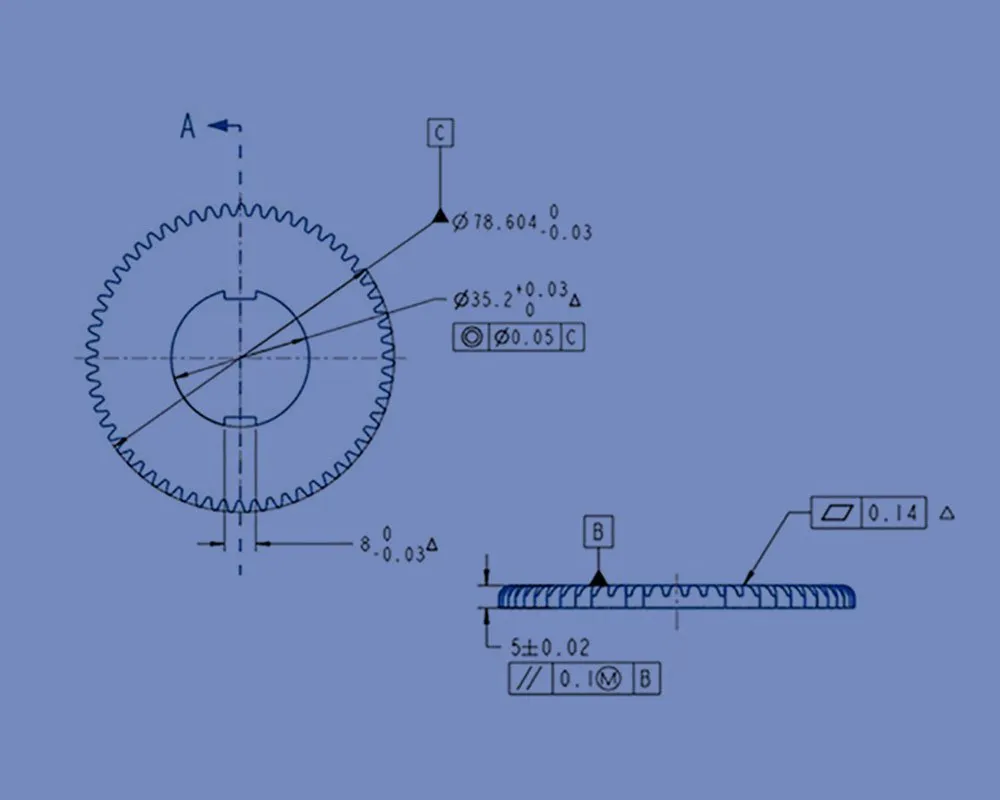
Fine Blanking technology plays a crucial role in the manufacturing of metal parts for industries such as automotive, medical, electronics, industrial, and furniture. This advanced metal forming process has brought revolutionary changes to the manufacturing industry, making the production of high-precision, high-quality parts more efficient and economical.
What is fine blanking process
Fine Blanking, as the name suggests, is a precision metal cutting process. It has evolved from traditional stamping techniques but offers significant improvements in both manufacturing principles and processing results.
This advanced technology has enabled manufacturers to produce complex parts with tight tolerances and superior surface finish in a single operation, which would otherwise require multiple secondary operations using conventional stamping methods. The ability to produce near-net-shape components with minimal material waste and reduced post-processing requirements has made Fine Blanking an attractive option for various industries seeking cost-effective solutions for high-volume production of precision parts.
fine blanking vs conventional blanking
Fine blanking technology represents a significant improvement over traditional stamping processes. While traditional stamping is fast and cost-effective, it often falls short of meeting the stringent precision and surface quality requirements of high-end manufacturing industries. In contrast, fine blanking technology, through innovative process design, achieves remarkable advantages.
The fine blanking process virtually eliminates deformation at the edges of parts, ensuring geometric precision. Our fine blanking technology can control flatness and perpendicularity to within 0.03mm, and can even achieve extremely high precision of up to 0.01mm. The smooth sheared surface of fine blanked parts can reach over 90% of the material thickness, greatly enhancing the product’s aesthetics and functionality.
Furthermore, the fine blanking process produces minimal fracture zones, and burrs are almost negligible. After barrel polishing treatment, a completely burr-free smooth surface can be achieved. Fine blanking technology also ensures high precision of the cut surface, greatly improving the assembly performance of parts.
fine blanking vs conventional stamping
Under the same quality requirements, fine blanking technology, with its high-efficiency characteristics, has become an ideal alternative to traditional processes such as machining and powder metallurgy. Fine blanking not only significantly improves production efficiency but also substantially reduces processing costs, creating higher value for customers. This perfect combination of high efficiency and low cost has led to the increasingly widespread application of fine blanking technology across various industries.
Custom Metal Fine Blanking
Our fine blanking technology is utilized in diverse industries, producing high-precision metal parts for automotive gears, medical instruments, electronics connectors, and industrial valves. We maintain industry-leading precision and efficiency with advanced equipment and stringent quality control measures. Continuous innovation drives us to meet evolving customer needs. Our flexible production lines cater to personalized requirements, ensuring swift and reliable delivery services for urgent orders.
Leave a Comment