Your China & Yunnan Travel Experts

 Ask a Question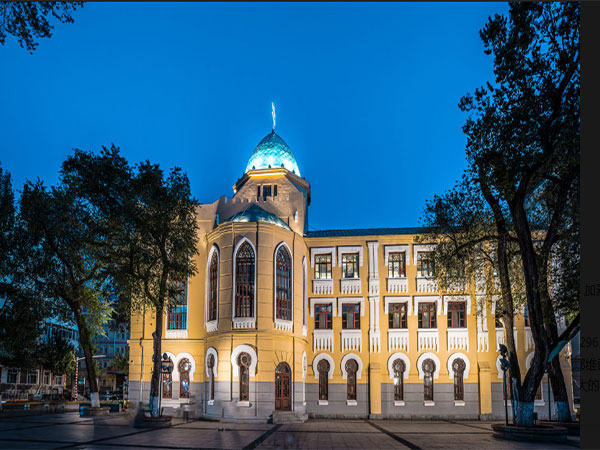
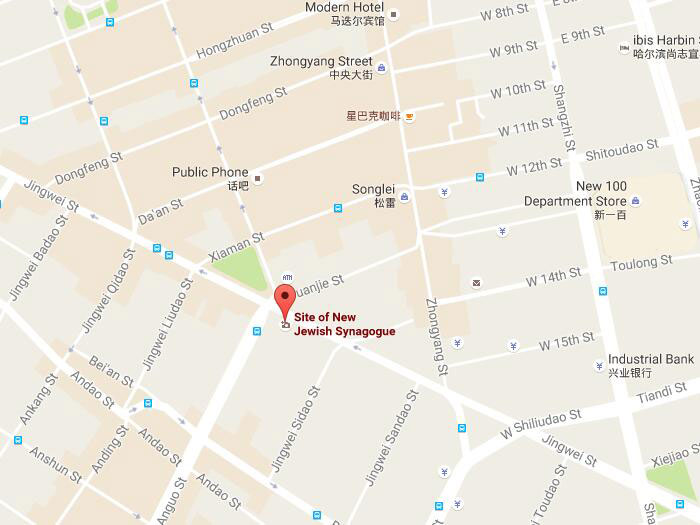
No. 162 Jingwei Strret, Daoli District, Harbin, Heilongjiang Province.
Architecture with Arabic style.
New Jewish Synagogue (Chinese name: 犹太教新会堂), which not only provides a narration of the Jewish religion in the city but also a home to an extensive collection of Jewish culture and artifacts.
The New Synagogue lies in Jingwei Street, Daoli district, bordering the city center. It is the second Jewish synagogue in Harbin and was established in addition to the main synagogue, known as the Old Synagogue. The New Synagogue was built in 1918 and finished in 1921; the New Jewish Synagogue covers an area of more than 1,230 square meters and could accommodate as many as 800 worshipers. It is the largest in northeast China.
For tourists, the synagogue is one of the must-see attractions in Harbin due to its unique architecture and culture. Each year, many descendants of the Harbin Jews return to their roots and scholars of Jewish culture also come to study their heritage. The collection presents a vivid description of Jewish religious, political, economic and cultural activities in Harbin in the early 20th century. Depicting living situations at the time, family settings have been recreated in several small halls, where an old piano, classic clock, artifacts and daily necessities enrich visitors' imagination of life in the city. The New Jewish Synagogue enables a unique look back into Harbin’s colorful modern history and the friendships of two peoples.
In the late 19th and early 20th centuries, with the construction of the Chinese Eastern Railway, a large number of Russian Jews came to Harbin. In 1908, the Hasidic Jewish sect in Harbin established a "Minon," a small-scale family prayer house, at the home of P.M. Kang En on Daoli Street. However, at that time, the prayer houses of believers were not fixed in place and moved many times.
Following the Russian October Revolution, a large influx of Jews entered Harbin. The existing synagogue could no longer accommodate the new Jewish population, so in 1916, the Religious Council decided to build a new synagogue. In 1917, Fainland and Khokhlovkin donated the land on Xiewen Street (now Jingwei Street) to the Religious Council for the site of the new synagogue. On September 21, 1918, the groundbreaking ceremony was held for the new synagogue, designed by the renowned Jewish architect Joseph Yurievich Levikin. On September 25, 1921, the new synagogue was completed and inaugurated, becoming the second Jewish synagogue in Harbin and the largest synagogue in Northeast China.
After its completion, the new synagogue faced the crisis of being repossessed by creditors and converted into a cinema, as its construction funds mainly came from loans from Japanese banks. It was later redeemed through donations from the Jewish community. After the liberation of Harbin, Jewish residents began leaving the country around 1950, and the new synagogue closed in 1956. Subsequently, the site was used for various purposes, including as the Harbin Public Security Bureau club. In 2004, the government renovated it and converted it into the "Harbin Jewish History and Culture Museum," which officially opened to the public in 2009.
Completed in 1921, Harbin New Synagogue is a brick-and-stone structure designed by renowned Jewish architect Joseph Yuryevich Levkin, covering an area of 1,296 square meters with a building area of 1,233 square meters that can accommodate 800 people for religious services. Its distinctive facade features a three-door main entrance, where four columns in the protruding section support pointed arches to create a solemn and hierarchical look, while the horseshoe-shaped doors and windows—typical elements of Jewish architecture—add unique artistic charm. The most striking feature is the huge semicircular dome rising from the roof of the square-shaped main hall, which enhances the building’s visual grandeur and meets the functional and symbolic needs of Jewish religious architecture. Inside, the reasonable layout highlights the solemnity of religious activities, and although the decoration has been simplified after restoration, it retains the essence of traditional Jewish synagogue design, emphasizing elegance and serenity, while the integration of Jewish architectural traditions with local construction techniques reflects the fusion of diverse cultures.
Subway: Take Line 2 to Central Avenue Station, exit from Exit 3, and walk for about 10 minutes.
Bus: Take bus routes 2, 21, 75, or 105 and get off at the "Jingwei Sixth Street" stop. Then walk 100 meters east along Beian Street, and then 250 meters north along Jingwei Fifth Street. Alternatively, take bus routes 1, 13, 15, 20, 42, 47, 53, 61, 113, 116, or 131 and get off at the "Daoli Twelfth Street" stop. Then walk 200 meters west along Xiaman Street, and then 150 meters south along Tongjiang Street.

From on request

From on request

 English