Your China & Yunnan Travel Experts

 Ask a Question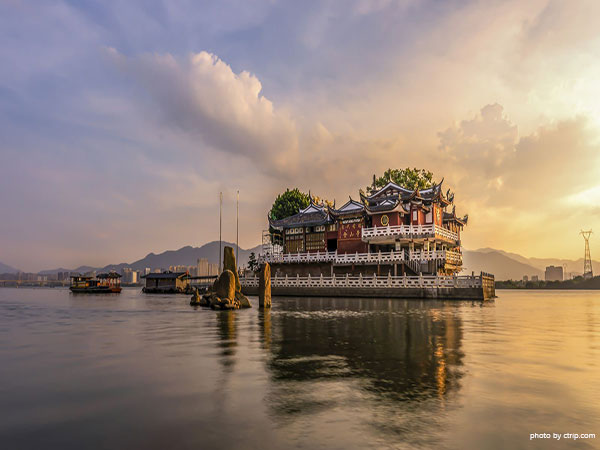
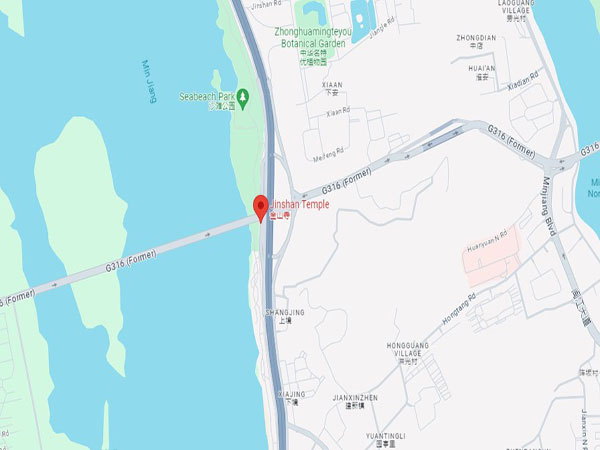
Near the intersection of West Third Ring Road and Hongtang Bridge in Cangshan District, Fuzhou City, Fujian Province.
the only temple in Fuzhou that stands in the water
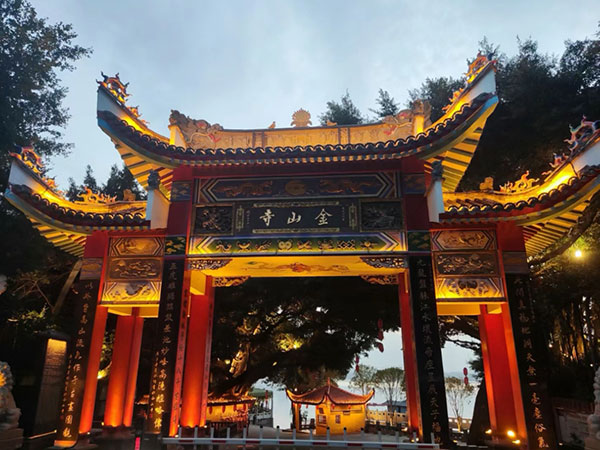
Jinshan Temple, a famous tourist attraction along the Minjiang River, is located near the intersection of Xisanhuan Road and Hongtang Bridge in Cangshan District, Fuzhou City, Fujian Province. It consists of four parts: stone pagoda, Mazu Hall, wing rooms, and Wenchang Temple, covering an area of 375 square meters. Originally a small rocky hill in the middle of the river, Jinshan Temple got its name because its shape resembles a floating stone seal on the water surface and is reminiscent of Jinshan in Zhenjiang City in southern Jiangnan region; hence it is called "Xiao Jinshan".
Origin of the Name (Song Dynasty)
Jinshan Temple in Fuzhou was first built during the Shaoxing period of the Southern Song Dynasty (1131). At that time, there was a natural small rocky hill in the middle of the Wulong River, shaped like a seal floating on the water, with a geographical feature similar to Jinshan Mountain in Zhenjiang, Jiangsu. Therefore, the locals named it "Little Jinshan" based on the scenery, and the temple was also named "Little Jinshan Temple".
Founded in the Southern Song Dynasty: The Origin of Building Temples on Water
Fuzhou's Jinshan Temple was first constructed during the Shaoxing era of the Southern Song Dynasty. In the middle of the Wulong River stood a natural granite outcrop rising above the water, resembling a floating seal. Monks built the temple upon this rock and erected a stone pagoda atop it. Resembling a “golden seal floating on water,” it was named “Little Golden Mountain,” and the temple likewise became known as “Jinshan Temple.”
The early temple complex was modest in scale, with structures built close to the rock formation. Centered around the stone pagoda, it formed a layout where “the pagoda served as the core, with halls built around it.” Surrounded by water on all sides, it presented a unique form of a temple on water from its very inception.
Yuan and Ming Dynasties: Expansion and Prosperity
During the Yuan and Ming periods, Fuzhou's water transport flourished, and the Wulong River became a vital waterway. Situated prominently in the river's center, Jinshan Temple gradually became a landmark for passing vessels, attracting increasing numbers of worshippers.
The temple underwent multiple renovations and expansions, gradually refining its halls and structures. Though constrained by the rock's limited surface area, compact layered construction created a distinctively tiered, three-dimensional layout. In the 43rd year of the Wanli reign (1615), floods destroyed the stone bridge connecting it to shore. Never rebuilt, Jinshan Temple became a truly isolated “water temple” in the middle of the river.
Qing Dynasty: Flooding and Decline
Frequent flooding during the Qing Dynasty caused repeated damage to the structures from river erosion. Despite multiple repairs, the temple's scale gradually diminished. Late Qing turmoil and social upheaval further diminished pilgrimage, leading the temple to fall into disrepair. Only the core buildings and stone pagoda remained intact.
Republican Era Reconstruction and Contemporary Preservation
In 1934, local philanthropists funded the temple's reconstruction, restoring halls and reinforcing stone foundations, establishing its present layout.
Following the founding of the People's Republic, the temple faced fluctuations. Post-reform, it gradually reopened and underwent restoration. Amid urban development, Jinshan Temple transformed from a riverside relic into a pivotal historical landmark of Fuzhou, preserving its unique character as an “isolated temple in the water.”
Jinshan Temple is the only temple in Fuzhou that stands in the water. The temple is built according to the terrain and natural scenery, surrounded by railings. Due to its location, there are no towering halls or huge Buddha statues, but the exquisite architecture reflects beautifully on the water, making it particularly unique. Jinshan Temple stands alone in the middle of a river and cleverly uses its surroundings to create a serene and spacious atmosphere that is truly one-of-a-kind. Leaning on the railing and looking far away, you can see the green waves rippling and the sails floating. The main attractions include Hongtang Bridge, Front Hall, Mazu Hall, Jinshan Pagoda, Daci Building, Yiyi Zhai, Jiejie Room, Longfeng Pavilion, etc.
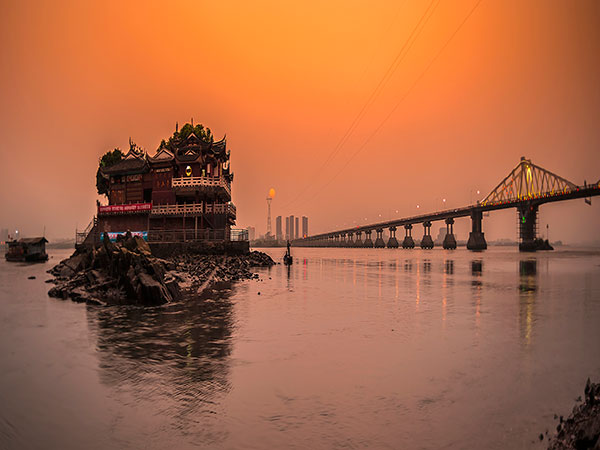
Hongtang Bridge (洪塘大桥) crosses the river not far from Jinshan Temple, located on the Wulong River near Hongtang Village in the western suburbs of Fuzhou City. Hongtang Bridge flies over like a rainbow from its side, connecting the west bank of the river named after it, Jinshan Economic Development Zone and Jinshan Bishui Living Area. This is a good spot to take pictures of Jinshan Temple. On sunny days, you can watch the spectacular sunset in the river. The entire Jinshan Temple will be illuminated by lights around 5:30 p.m., enhancing its allure.
There is an ancient banyan tree on the crevice of the foundation stone of Jinshan Temple, which looks like the welcoming pine of Huangshan. This tree is like a guardian, quietly guarding this temple, accompanying it through wind, frost, rain and snow, and witnessing the changes of history.
Jinshan Pagoda (金山塔) is the central building of the temple, standing at approximately ten meters tall with a simple design. The front of the pedestal features stone steps and stone railings on both sides. The pagoda is a solid stone structure with seven levels and eight sides, constructed from 185 pieces of white pear stones. The body of the pagoda is adorned with various patterns such as eaves, lintels, doors, and windows, all intricately crafted together. When the tide rises in Minjiang River, the sight of the pagoda floating in the middle of the river is quite spectacular. In front of the pagoda stands a Mazu Hall (妈祖厅)built to worship Mazu as an expression of reverence for the goddess of oceans. Behind the pagoda lies the Daci Building(大慈楼), which is built to commemorate the great compassion and mercy of Guanyin Bodhisattva.
There are two small side rooms on both sides of the front of the Daci Building. The left is Yiyi Zhai(怡怡斋), where Zhang Jing, a famous anti-Japanese general, and Weng Zhengchun, a champion, and others studied during the Jiajing period of the Ming Dynasty (1522-1566). The right is Jiejie Room(借借室), where Lin Zhaoen, a scholar from Putian, wrote books during the Jiajing period of the Ming Dynasty. He was also the founder of the San Yi Sect. The daily utensils were all borrowed from nearby villagers, so this room was called "Jiejie Room".
From the left side door inside the Daci Building, you can head towards the outside of the building and then descend down the spiral staircase located next to the ancient banyan tree. There, you will find a charming small pavilion called Longfeng Pavilion(龙凤亭) that extends towards the river. This delightful spot is perfect for tourists in need of a peaceful resting place.
How to get there
Jinshan Temple is located in the middle of the Wulong River in Cangshan District, Fuzhou. Visitors must first reach the riverside ferry terminal and then take a boat to the island.
By Bus
Take bus routes 39, 55, 150, 168, 506, 510, etc., from downtown Fuzhou and get off at “Jinshan Temple Station.” Walk a few minutes to the riverside ferry terminal, then take a boat to the temple.
Taxi / Ride-Hailing
Navigate directly to “Jinshan Temple Ferry” or “Jinshan Temple Scenic Area near Hongtang Bridge.” Upon arrival, walk to the ferry terminal for a convenient and time-saving journey.
Driving
Navigate to the Jinshan Temple Scenic Area parking lot near Hongtang Village in Cangshan District. After parking, walk to the ferry terminal and take a boat to the island.
Boat Travel Notes
Jinshan Temple is located in the middle of the river, requiring a short boat ride to reach. Tickets are typically round-trip, with prices subject to on-site confirmation. Daytime visits are recommended, and be mindful of weather and water level conditions.

 English
