Your China & Yunnan Travel Experts

 Ask a Question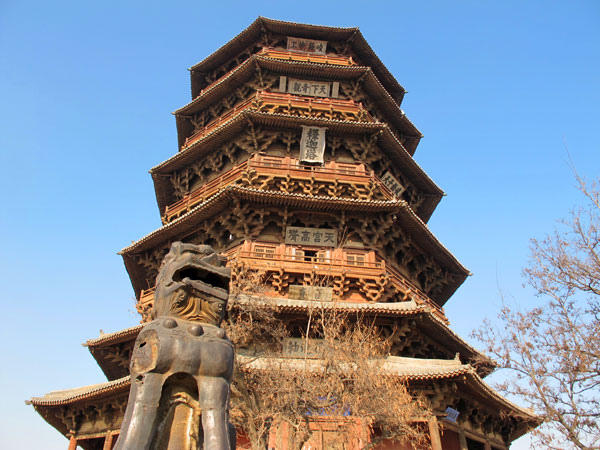

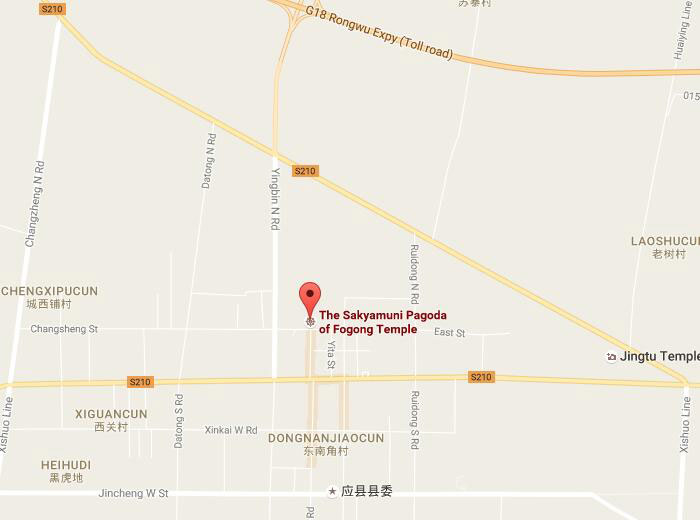
Yingxian County, 76km (47 miles) south of Datong, China
Top 4 amazing pagodas in the world.
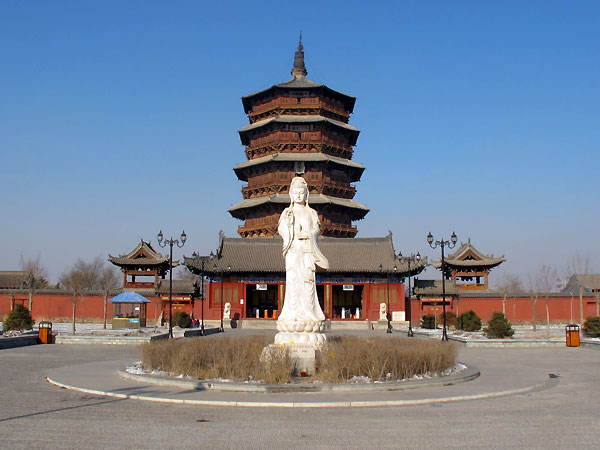
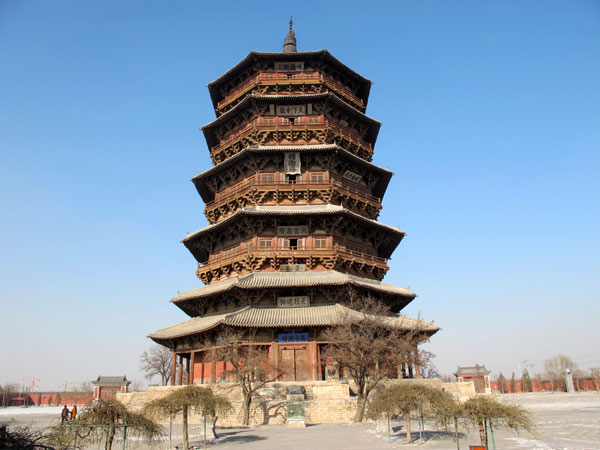
Yingxian Wooden Pagoda (Sakyamuni Pagoda of Fogong Temple) is sited in Yingxian County, Datong, Shanxi Province, China. It is a wooden Chinese pagoda built in 1056, during the Khitan-led Liao Dynasty. This Pagoda is regarded as one of the three pagodas in the World, together with the Eiffel Tower in France and Pisa Leaning Tower of in Italy. Built in 1056 during the Liao Dynasty, this wooden pagoda has a history of over 1000 years, being the oldest and highest existing wooden pagoda in China and around the world. It is built on a four-meter-high groundwork with a total height of 67.31 meters, and a diameter of 30.27 meters at the bottom. It is recorded that it has survived seven earthquakes in the history, especially a great earthquake happened in the Yuan Dynasty (1328 A.D.) that lasted for seven days, which testifies its rational use of components and fine construction.
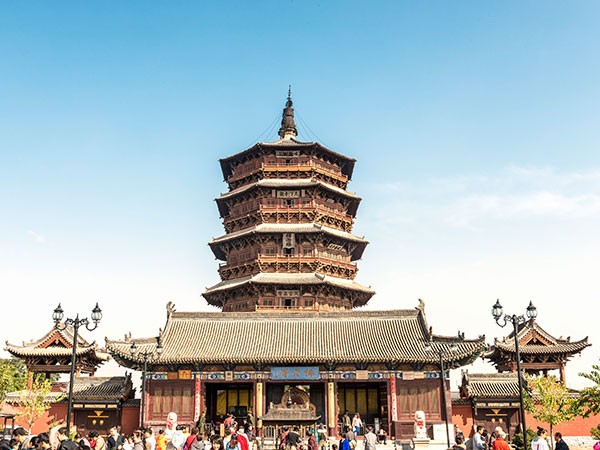
The pagoda was constructed under the Khitan-led Liao Dynasty, a period marked by profound Buddhist influence and architectural innovation. For nearly a millennium, it has served as a spiritual beacon, housing sacred Buddhist artifacts and inspiring pilgrims and scholars alike. In 2013, it was included on China’s tentative list for UNESCO World Heritage status, alongside the nearby Fengguo Temple, underscoring its global cultural importance.
Exterior Design
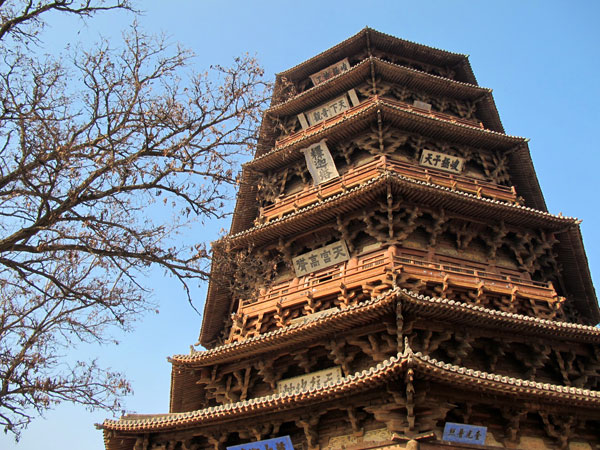
From the outside, the pagoda appears to be a five-story structure, but it ingeniously incorporates nine interior levels. Its octagonal shape, symbolizing the Buddhist Eightfold Path, rises to a height of 67.31 meters (220 feet), with a base diameter of 30.27 meters (99 feet). The pagoda is crowned by a 14-meter-tall iron spire, which functions as an ancient lightning rod, connected to the ground by eight iron chains—a remarkable feat of foresight that has protected it from lightning strikes for centuries.
Structural Ingenuity
Constructed entirely without nails, the pagoda relies on a complex system of 54 types of interlocking brackets (dougong) and tenon-and-mortise joints. This double-barrel wooden framework allows the structure to flex and absorb external forces, contributing to its legendary resilience. Historical records note that the pagoda has withstood seven major earthquakes, including a severe tremor during the Yuan Dynasty (1328 A.D.) that lasted seven days. The pagoda’s design, with its soft wood texture and layered reinforcement, mimics the stability of modern seismic-resistant buildings.
Interior Artistry
Inside, the pagoda is adorned with exquisite frescoes and a gilded statue of Sakyamuni dating back to the Liao Dynasty. During a 1974 renovation, engraved sutras and construction-related documents were discovered within one of the Buddha statues, offering invaluable insights into its history. Unfortunately, to preserve the delicate structure, visitors are currently permitted only up to the second floor. Nevertheless, the intricate carvings, majestic statues, and atmospheric interior provide a profound sense of connection to the past.
Cultural and Spiritual Legacy
The Yingxian Wooden Pagoda is more than an architectural wonder—it is a sacred site embodying the spiritual aspirations of the Liao Dynasty. Each level of the pagoda represents a stage toward enlightenment, and the artifacts within reflect the deep integration of Buddhist philosophy into daily life. Its enduring presence symbolizes harmony between humanity and nature, a core tenet of Chinese culture.
Many wood pagodas in China were destroyed by lightening. Since a 14 meters tall iron decoration on top of the pagoda connected by eight iron chains to the ground works very much like a modern lightning rod, the wood pagoda did not suffer any damage from lightening.
In 2013, the pagoda was placed on China's tentative list for UNESCO World Heritage Site consideration, along with the Fengguo Temple.
【Chinese name】: 应县木塔 (Yìngxiàn Mùtǎ)
【Recommended time to stay】: 2 hours
【How to get there from Datong】:
Best Time to Visit: The ideal seasons are spring (April to June) and autumn (September to October), when the weather is mild and pleasant, and the skies are often clear. It is highly advisable to avoid Chinese national holidays, such as the Labor Day (May 1st) and National Day (October 1st) "Golden Weeks," when domestic tourism surges and the site can become unpleasantly crowded.
Ticket and Practical Tips:
From $ 531
From $ 644

 English