Your China & Yunnan Travel Experts


 Ask a Question
Kunming, the capital of Yunnan Province, is the political, economic, and cultural center of the province, as well as its most important transportation and communication hub. Located on the Yunnan–Guizhou Plateau in southwest China, Kunming occupies a strategic position linking inland China with Southeast Asia and South Asia. For centuries, it has served as a gateway between China and regions such as Myanmar, Laos, Vietnam, and India.
With a history of more than 2,400 years, Kunming gained early importance as a key stop on the ancient South Silk Road, which facilitated trade, migration, and cultural exchange between China’s interior and South and Southeast Asia. Today, this historic role is reflected in Kunming’s modern transport network. Thanks to continuous infrastructure investment over the past decade, the city has become significantly easier to reach by air, high-speed rail, and highway, making it one of the most convenient entry points for exploring Yunnan Province.
For foreign visitors, Kunming often serves as the first stop in Yunnan before continuing on to destinations such as Dali, Lijiang, Shangri-La, Xishuangbanna, or the Stone Forest. Understanding Kunming’s transport system can greatly improve travel efficiency and help visitors plan smoother itineraries.
In recent years, the airport has continued to expand its capacity, terminals, and international connections. Today, it handles hundreds of flights daily and offers modern facilities, including English signage, currency exchange counters, international dining options, luggage storage, and free Wi-Fi, making arrival relatively smooth for foreign travelers.
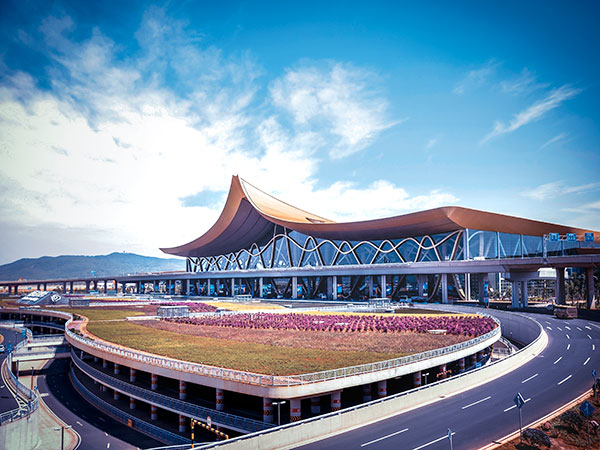
For foreign tourists, this means Kunming can be used as an alternative entry point into China, particularly for travelers coming from Southeast Asia. Compared with larger hubs like Beijing or Shanghai, immigration procedures at Kunming Airport are often less crowded.
►Getting from the Airport to Downtown:
Metro (Recommended): The most efficient way. Metro Line 6 runs directly from the airport terminals to the city center, connecting with the entire metro network at key transfer stations like Tangzixiang (Line 2) and Dongfeng Square (Line 3). The ride takes about 30-40 minutes and costs around RMB 5-7. Follow the clear bilingual signs in the arrival hall.
Airport Shuttle Buses: Several lines (e.g., Line 1 to Xiyuan Hotel/Nanyao) serve major downtown points. Cost is approximately RMB 25, and the journey takes 50-70 minutes depending on traffic. Tickets are sold at counters outside the arrivals hall.
Taxi & Ride-Hailing: Taxis are readily available. A ride to the city center (e.g., Green Lake Park area) costs roughly RMB 80-120, including tolls. Use Didi (China's Uber) for easier payment and route transparency. Ensure your app is set up before arrival. Agree on using the meter ("dǎ biǎo") if taking a regular taxi.
Across China: Guiyang (2-2.5h), Chongqing (4-4.5h), Chengdu (6h), Guangzhou (6-7h), Nanning (5h), Shanghai (10-11h), Beijing (10-12h). Booking in advance on platforms like Trip.com or the China Railway app (12306) is highly recommended, especially during holidays.
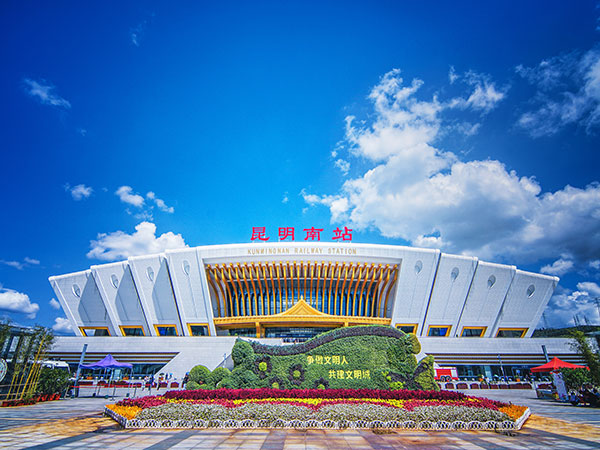
Within Yunnan, high-speed trains now whisk travelers to Dali in just 2 hours and to Lijiang in about 3 hours, traversing stunning mountain and river landscapes that were once a full day's arduous journey. Other provincial connections include Pu'er and Xishuangbanna (Jinghong, ~3-3.5h), making previously remote areas easily accessible.
Kunming Highway traffic is very convenient, its extensive highway network is excellent for specific day trips or regional exploration. For nearby destinations not yet served by HSR, such as the Stone Forest (Shilin) or Jiuxiang Scenic Area, tourist buses from Kunming South Bus Station or Kunming East Bus Station are available. However, for popular routes like Dali or Lijiang, the high-speed train is almost always faster and more comfortable.
Kunming's expanding metro system is clean, efficient, and tourist-friendly. Lines 1, 2, 3, 4, 5, and 6 cover most areas of interest, including major train stations, Green Lake Park, Nanping Street, the Yunnan Provincial Museum, and Dianchi Lake. Purchase single-journey tokens or use a Kunming Transportation QR code via Alipay/WeChat. Fares range from RMB 2-7.
Didi (Chinese Uber) is ubiquitous and convenient. For regular taxis, the flag-fall fare is RMB 8-10 for the first 3km, then RMB 1.8-2.4 per additional kilometer. A 50% surcharge may apply for trips beyond 10km. Pro Tip: Have your destination written in Chinese or pinned on a map to show the driver when you take a taxi.

 English