Your China & Yunnan Travel Experts


 Ask a Question
Famous Landmarks in Datong are considered the Name Card of Datong, like the Yungang Grottoes, Hanging Temple, Yingxian Wooden Pagoda, etc. ancient and new. They are somehow, represent a certain character or role Datong played to the world. Come with Top China Travel, to witness and appreciate those famous Datong Landmarks.
Yungang Grottoes 云冈石窟
Yungang Grottoes, located about 16 km southwest of the city of Datong, is one of World Culture Sites and is said to be the best preserved sites in China with 53 caves containing over 51,000 stone carvings of Buddha and Buddhist.
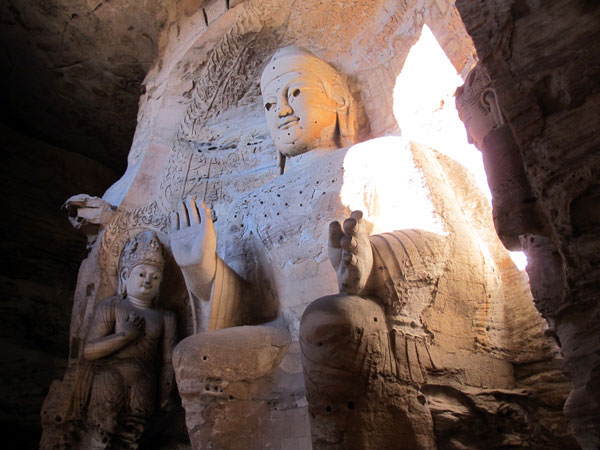
Yungang Grottoes was mainly constructed between 460-525 AD, representing exceptional feat of Buddhist cave art in China in the 5th and 6th century. It has got a total number of 53 grottoes consisting of more than 51,000 Buddha statues and statuettes. The fusion of Buddhist religious symbolic art from central and south Asia with Chinese cultural tradition is the noted highlight of the site. It has been quite successful in vividly illustrating the power and endurance of the Buddhist belief in China. It is a must see destination for you if you are the one who loves to explore the architectural brilliance of the world.
Hanging Temple
Hanging Temple, the most famous scenic spot in Mt. Hengshan, has stood at the foot of Mt. Hengshan for over one thousand years. Leaning on the precipitous mountain face and facing a deep valley, the temple was constructed in a unique way, which is the buildings are supported by sturdy wooden pillars inserted in holes cut in the mountain body. Seeing it from the distance you could find it hanging in the mid air miraculously, hence the name "Hanging Temple".
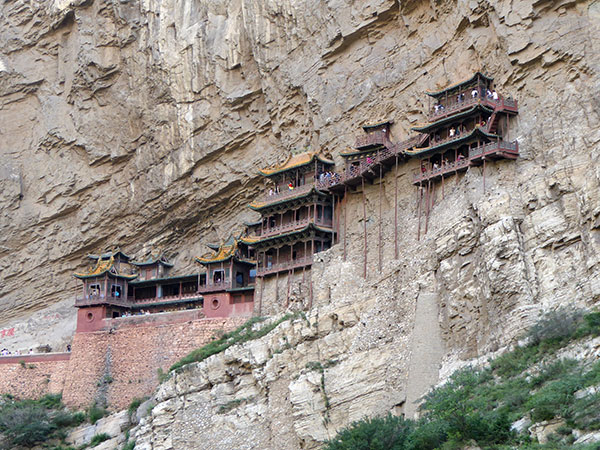
Tourists can walk upwards along the steep stone pathway to visit some 40 exquisite and unique halls in the temple. This is the special monastery in which you could find not only the elements of Buddhism but also Taoism and Confucianism. There are around 40 halls with 80 sculptures which are vividly carved from copper, iron, terracotta and stone in this temple. A visit to the Hanging Temple will be a happy adventure at the same time. Seen from the buildings, it looks as if facing an abyss; seen from the bottom of the valley, the cliff is lofty like a rainbow; seen from the opposite side over the valley, it looks like a young flying phoenix on the cliff. It is just like what the inscription on the cliff of plank roads reads, People are more creative than nature.
Mount Hengshan 恒山
Mount Hengshan is one of China’s Five Sacred Mountains and an important Taoist holy site. The mountain is known for its steep cliffs, deep valleys, and dramatic natural scenery. Hanging Temple is built on the western cliff of Jinlong Gorge, perfectly blending human construction with the mountain landscape. Visitors to Mount Hengshan can enjoy hiking, temple visits, and panoramic views, making it a popular destination for both religious pilgrims and nature lovers.
Yingxian Wooden Pagoda 应县木塔
Yingxian Wooden Pagoda (Sakyamuni Pagoda of Fogong Temple), built in 1056, is regarded as one of the three pagodas in the world, together with the Eiffel Tower in France and Pisa Leaning Tower of in Italy.
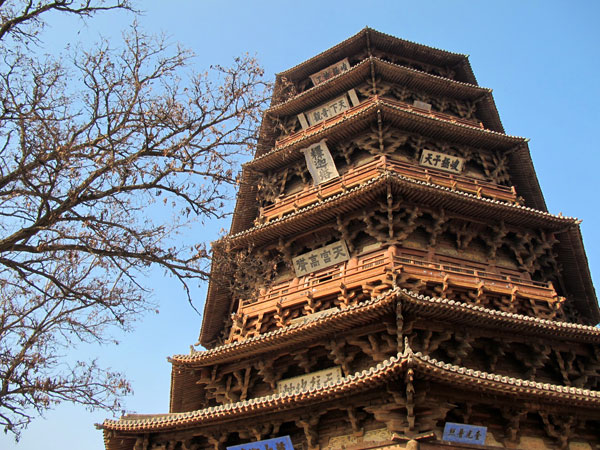
This impressive building is China's oldest surviving wooden pagoda and has a history of over 1000 years. It is built on a four-meter-high groundwork with a total height of 67.31 meters, and a diameter of 30.27 meters at the bottom. From the outside, it appears to have only five stories, though it actually has nine; and its complex system of supports includes 54 kinds of brackets. Frescoes on the ground floor and a gilded statue of Sakyamuni date from the Liao Dynasty. During a 1974 renovation, engraved sutras and documents related to the construction of the pagoda were discovered inside one of the statues of Buddha.
Nine-Dragon Screen 九龙壁
The Nine-Dragon Screen in Datong is the largest and best-preserved glazed dragon screen in China. It was built during the Ming Dynasty in front of the residence of Zhu Gui, the 13th son of Emperor Zhu Yuanzhang. The screen features nine vividly crafted dragons made with fine glazed tiles and represents the highest level of decorative architectural art of the Ming period.
Datong Ancient City Wall 大同古城墙
Datong Ancient City Wall was rebuilt in 1372 during the Ming Dynasty on the foundations of earlier city walls from multiple dynasties, including the Han, Tang, Liao, and Yuan. The wall is about 14 meters high and stretches for 7.2 kilometers, with four main gates, corner towers, watchtowers, and a surrounding moat. It is one of the most complete ancient city walls still standing in China and clearly shows Datong’s historical role as the “Northern Gateway” guarding the central plains.
Drum Tower (Gulou)(鼓楼)
Located at the center of Datong Ancient City, the Drum Tower was first built during the Ming Dynasty. The lower level is constructed of brick and stone, while the upper structure is wooden. In ancient times, it served as the city’s timekeeping center. Today, the Drum Tower is a cultural landmark and an important reference point for exploring Datong’s old city.
Sipailou (Four Archways)(四牌楼)
Sipailou is a group of four connected archways built during the Hongwu period of the Ming Dynasty. The archways face east, west, south, and north, symbolizing balance and symmetry in traditional Chinese urban design. The street names carved on the archways were written by a Qing Dynasty calligrapher, making Sipailou both an architectural and cultural symbol of Datong.
Huayan Temple 华严寺
Huayan Temple was first built in 1062 during the Liao Dynasty and is one of the oldest and best-preserved Liao–Jin temple complexes in China. The Mahavira Hall dates back to the Jin Dynasty and remains largely intact. Inside the temple, the clasped-hands Bodhisattva with a gentle smile is often called the “Oriental Venus.” Another highlight is the miniature “Heavenly Palace Pavilion,” considered a masterpiece of Liao Dynasty architectural art.
Shanhua Temple(善化寺)
Shanhua Temple is the largest and most complete surviving Jin Dynasty temple complex in China. Known for its simple and solemn style, the temple features wide eaves, ancient wooden structures, and towering old cypress trees, creating a peaceful and sacred atmosphere.
Guandi Temple 关帝庙
Guandi Temple, located on Gulou East Street, houses one of the few remaining Yuan Dynasty wooden buildings in Datong. The temple is dedicated to Guan Yu, a historical figure symbolizing loyalty and righteousness in Chinese culture.
Datong Confucian Temple / Fuxue(府文庙)
The Datong Confucian Temple once served as the city’s official school and a place for worshipping Confucius. Architectural features such as the Lingxing Gate and stone inscriptions reflect Datong’s strong educational tradition and cultural heritage.
Wenying Lake 文瀛湖
Wenying Lake is located in the city center of Datong and covers an area of about 400 hectares. Surrounded by greenery and backed by Baideng Mountain, it is a popular place for walking, relaxing, and enjoying lake views.
Datong Volcano Group Geopark
Datong Volcano Group Geopark is the largest and best-preserved intraplate rift volcano cluster in North China. The area features volcanic cones, lava formations, and unique volcanic rocks. The geopark offers both scientific value and sightseeing opportunities, making it a rare and distinctive natural attraction near Datong.
►More famous attractions in Datong please click Datong Attractions
►Highly recommended Datong Tours at Classic Datong Tours

 English