Your China & Yunnan Travel Experts

 Ask a Question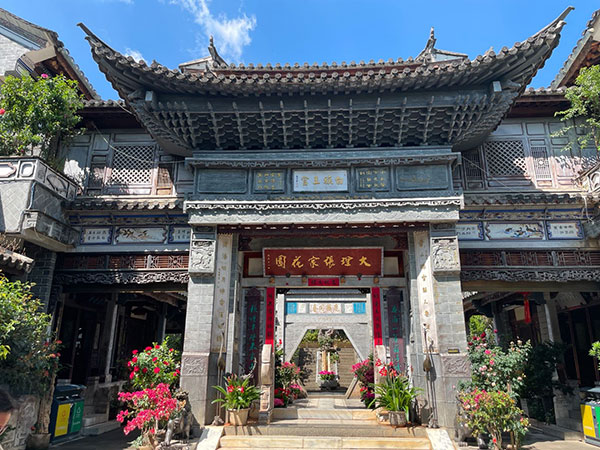
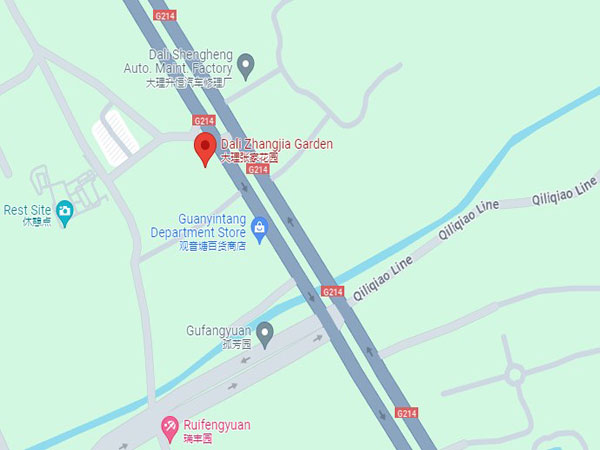
North of Guanyintang, Qiliqiao, Dali City, Dali Bai Autonomous Prefecture.
Admire the intricate Bai architecture, enjoy tea and performances, and experience the rich cultural heritage.
Nestled just 4 kilometers north of the ancient city of Dali, the Zhangjia Garden is a hidden gem that beautifully showcases the rich cultural heritage of the Bai ethnic group. Located beside the "Guanyintang" and surrounded by the breathtaking landscapes of Yunnan, this garden is a must-visit for anyone looking to immerse themselves in traditional Bai architecture, folklore, and natural beauty.
The site of Zhangjia Garden has a storied history dating back to the Tang Dynasty. Originally, it served as the official residence where the kings of the ancient Nanzhao Kingdom hosted their guests. Unfortunately, the original structure was destroyed during the Yuan Dynasty. In the wake of China's reform and opening-up, a local Bai entrepreneur rebuilt the garden on the ruins, adhering to the traditional Bai architectural style. Another popular legend suggests that the site was once the harem of a Bai queen surnamed Zhang, and the garden was named in her honor to commemorate her high status and contributions.
Practical Information
Zhangjia Garden is a quintessential example of Bai architecture, seamlessly blending residential spaces with private gardens. The garden was designed and funded by Zhang Jianchun, a master of folk architecture, who envisioned it as a cultural and artistic haven. The garden comprises six main courtyards: Caiyun Nanyuan, Haitang Chunyu, Luhe Tongchun, Xiyang Hongyuan, Ruijie Sanfang, and Sihe Huifeng. Each courtyard is unique, featuring intricate designs and thoughtful layouts.
Sanfang Yizhaobi (Three Rooms and One Screen Wall)
Chinese name: 三坊一照壁
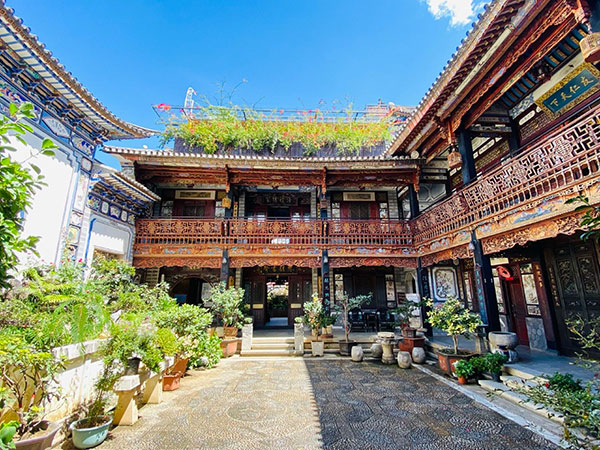
This classic Bai architectural style is prominently featured in Zhangjia Garden. The main room, or Xifang, serves as the living quarters for the head of the household, while the north and south rooms are designated for younger family members, guests, or as study rooms. Major family events and ceremonies are held in this central courtyard.
Sihe Wutianjing (Four Houses and Five Courtyards)
Chinese name: 四合五天井
Inspired by the traditional quadrangle courtyards of the Han Chinese, this layout is a hallmark of high-status Bai residences. All four houses are two-story buildings with uniform height, width, and depth, creating a harmonious and balanced aesthetic.
Xiyang Hongyuan (Western Red Courtyard)
This courtyard features a blend of Western architectural elements, adding a unique twist to the traditional Bai design.
Caiyun Nanyuan (Southern Courtyard of Colorful Clouds)
Chinese name:海棠春院
This courtyard is characterized by the architectural style of Weishan, located south of Erhai Lake, symbolizing the birthplace of the Nanzhao Kingdom.
Haitang Chunyu (Begonia Spring Courtyard)
A large pond occupies most of this courtyard, with a stage built over the water for performances. The surrounding seating areas provide a perfect spot for guests to enjoy the shows.
Luhe Tongchun (Deer and Crane Courtyard)
Chinese name:鹿鹤同春院
Serving as the central hub of the garden, this courtyard connects the six main courtyards through a series of covered walkways. A giant rock with the inscription "Luhe Tongchun" stands as the garden's emblem, symbolizing the unity of the six ancient Nanzhao states.
The Sky Pavilion offers panoramic views of the surrounding landscapes, including Jade Dragon Snow Mountain to the north, Yunnan to the south, Jishan sunrise to the east, and Cangshan to the west. With an open-air café and a book bar, it provides a serene space for relaxation and reflection, making it a spiritual retreat rather than just a residential area.
Zhangjia Garden is surrounded by camellias, rhododendrons, and eighteen streams flowing into Erhai Lake. The garden is also home to rare tea trees, making it a floral paradise often referred to as "Yunnan's First Garden" and a "Dreamlike Bai Residence."
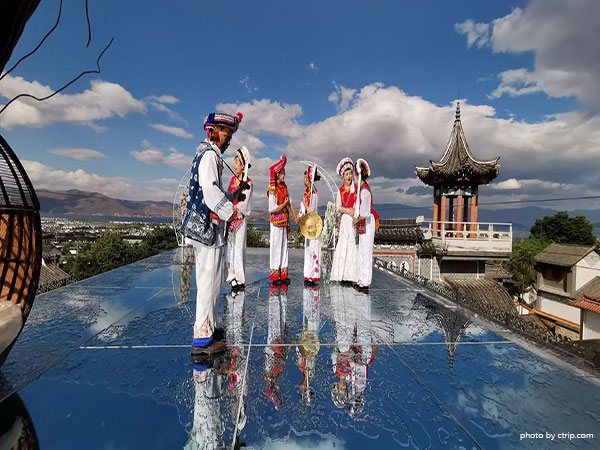
You can explore the exquisite architecture, enjoy traditional Bai tea, and watch captivating folk performances. The garden's ancient stage hosts daily Bai song and dance shows, as well as tea ceremonies, offering a rich cultural experience. Sipping Bai's famous three-course tea while watching these performances is a truly delightful experience.
From Dali Ancient City, take bus line 4 and get off at Guanyintang Station, approximately a 5-minute ride.
Zhangjia Garden stands as one of the finest examples of traditional Bai residential architecture. It adopts classic Bai layouts such as Sanfang Yizhaobi (Three Rooms and One Screen Wall) and Sihe Wutianjing (Four Houses and Five Courtyards). The main hall faces east toward the rising sun, reflecting the Bai people’s reverence for light and life. The screen walls, richly decorated with colorful paintings and carvings, often feature family mottos such as “Patience Brings Prosperity” (Bairen Jiafeng), symbolizing the family’s moral values and Confucian virtues.
Beyond the traditional aesthetic, Zhangjia Garden also embraces a fusion of East and West. Some courtyards, such as the “Western Red Courtyard,” display European-style elements like Roman columns, arched roofs, and fountains. These touches harmoniously blend with the Bai structures, highlighting the region’s openness to cultural exchange and innovation.
Every corner of the garden reveals exquisite craftsmanship — from wood carvings and stone sculptures to detailed paintings on beams and window frames. The carvings depict a variety of motifs, including flowers, birds, mythological creatures, and legendary tales like the Twenty-four Filial Exemplars, all executed with remarkable artistry that reflects the skill and dedication of Bai artisans.
Zhangjia Garden is also celebrated for its poetic landscapes, combining the elegance of Bai courtyards with the serenity of classical Chinese gardens. Over ten thousand camellia trees grow throughout the grounds, representing more than a thousand varieties. Famous types such as “Hentian Gao” (Reaching for the Sky) and “Tongzi Mian” (Child’s Face) bloom from October to March, filling the garden with color and fragrance. These vibrant blossoms, together with ancient trees, flowing water, and graceful pavilions, create a scene reminiscent of Dali’s renowned “Wind, Flowers, Snow, and Moon.”
The back garden evokes the charm of a Jiangnan-style water garden, featuring winding bridges, murmuring streams, and secluded paths that lead to tranquil corners. Visitors can climb to the upper-level pavilions to admire sweeping views of Cangshan Mountain and Erhai Lake. The “Mirror Flower Garden,” with its reflective ponds, lotus blossoms, and resident fish, adds a sense of calm and harmony — a perfect spot for contemplation or photography.
Originally built during the Qing Dynasty, Zhangjia Garden has been expanded and renovated over several generations. It bears witness to the rise and fall of the Zhang family and mirrors the changing fortunes of Dali itself. The garden encapsulates the evolution of Bai residential architecture — from simple wooden dwellings to grand courtyards adorned with delicate carvings and artistic flourishes.
Today, it serves not only as a scenic spot but also as a living museum of Bai culture. Its architecture integrates influences from the ancient Nanzhao and Dali Kingdoms, the Central Plains, and even Western cultures, demonstrating the Bai people’s openness, inclusiveness, and creative spirit.
For visitors, Zhangjia Garden is far more than a picturesque retreat. It offers a journey through history, art, and tradition — a place where you can appreciate exquisite architecture, wander among camellia blossoms, sip Bai three-course tea, and listen to folk songs that echo across the courtyards. Whether you’re a lover of culture, an admirer of architectural artistry, or a traveler seeking serenity, Zhangjia Garden is a captivating window into the soul of Dali and the timeless charm of Bai heritage.
From $ 333

 English
