Your China & Yunnan Travel Experts

 Ask a Question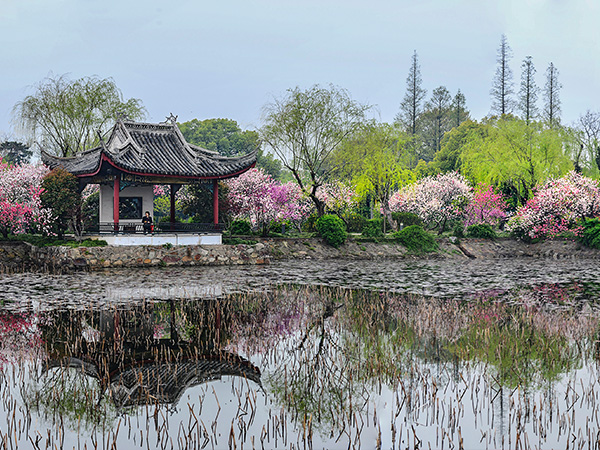


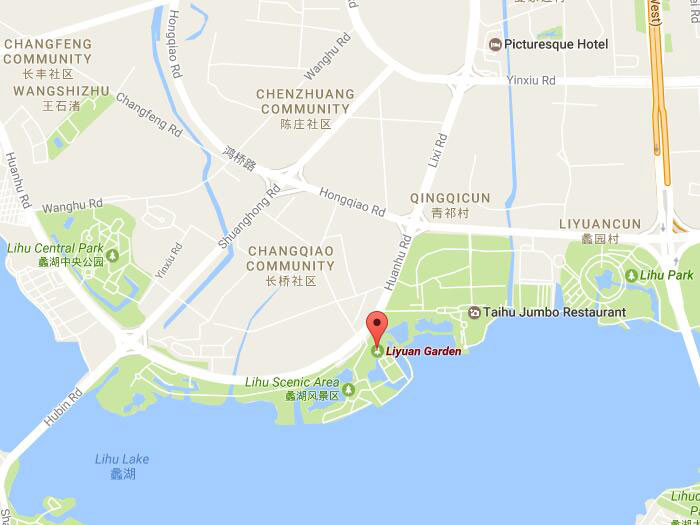
No.70 Qingqi Villege, Binhu District, Wuxi, Jiangsu Province, China.
One of the most beautiful gardens and parks in Wuxi
The Four Season Pavilion was built in 1954, which was named after the four seasons in a year. The Four Season Pavilions refer to the four pavilions, spring pavilion, summer pavilion, autumn pavilion and winter pavilion. The Spring Pavilion is also called Yihong Pavilion, and plums are planted near the Spring Pavilion. The Summer Pavilion is also called Dicui Pavilion, and oleander are planted near the Summer Pavilion. Autumn Pavilion is also called Zuihuang Pavilion, and osmanthus flowers are planted near the Autumn Pavilion. The Winter Pavilion is also called Yinbai Pavilion, where the wintersweet are planted. And there are always flowers blossoms at the Four Season Pavilion, making it beautiful and attractive all the year round.
The Hundred-Flower Mountain House was first built in 1930. It is located in the west of the entrance of the Li Garden. At the Hundred-Flower Mountain House, you can see the lake, rocks, rockeries, bamboos, pavilions, etc.
The Thousand Step Corridor was built in 1927. Strolling through the corridor, you can see the pavilions of the East Garden through the flower window. You can get different view on different step. At the Thousand Step Corridor, you can see the brick carving. There are 38 brick carvings at the Thousand Step Corridor, each of which is 7 meters long and 0.3 meters wide.
The Spring and Autumn Pavilion is mainly water landscapes. The pavilions are with well-designed layout. It is close to the Thousand Step Corridor, and the west side are rockeries.
Spring and Autumn Pavilion, with three floors, is the highest buildings in the Li Garden. It is named after the story of Fan Li and Xi Shi in the Spring and Autumn Period of Wu and Yue. On the ground floor of the pavilion hangs the plaque "Spring and Autumn Pavilion" written by Liu Haisu, and on the hall there is a picture of Fan Li's boating with Xi Shi. There are tea rooms on the second and third floors. Spring and Autumn Pavilion is a square pond in the west, where dikes are built and bridges are built, which is famous for reflecting the moon.
Know About the Story of Fan Li and Xi Shi
Visiting the Li Garden, you can not only enjoy the wonderful natural scenery of the pavilions, rockeries, plants and lakes, but also you can know about the history and story of the Li Garden. Li Garden got its name because of Fan Li. It is said that Fan Li and Xi Shi used to take a boat on the lake of the Li Garden. After escaping from King Goujian, Fan Li and Xi Shi lived in Li Garden and had a happy life here.
Enjoy the Spring Scenery in the Li Garden
At the Southern Causeway, hundreds of peach trees and willows are planted. In the spring, walking on the Southern Causeway, you can see the red peach blossoms and green willows, setting off one another in spring. When the breeze flows, the leaves of the willow trees are swaying, which is joyful and beautiful. There is Spring Dawn at Su Causeway in the West Lake in Hangzhou. And you can also enjoy the Spring Dawn at Southern Causeway in Li Garden.
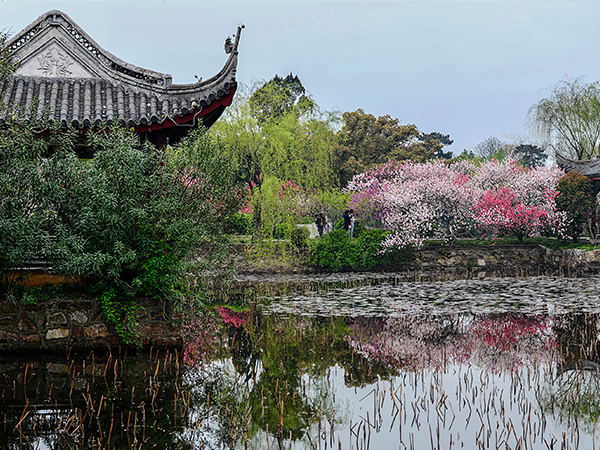
With various flowers and trees in the Li Garden, it is always beautiful in different seasons. And the best time to visit the Li Garden will depend on the scenery you prefer. In spring, you can see the peach blossoms at the Four Season Pavilions. And you can also enjoy the red peach blossoms and the green willows in the Southern Causeway, which is called the Spring Dawn at the Southern Causeway. In summer, you can see the lotus blossoms at the Huxin Pavilion and the Thousand Step Corridor. In autumn, you can see the red autumn leaves in the Li Garden. In winter, you can see the plum blossoms and the snow scenery in the Li Garden.
Subway: Take the Subway Line 4 and get off at the Lihu Daqiao Station, and get out of the station from Exit 1, then walk about 900 meters to the entrance of the Li Garden.
Bus: You may take Bus Route 1, 9, 20, 82, 211, 315, then get off at Liyuan Station (蠡园), of which Bus Route 1, 20 82, 211 is available in front of Wuxi Railway Station.

 English
