Your China & Yunnan Travel Experts

 Ask a Question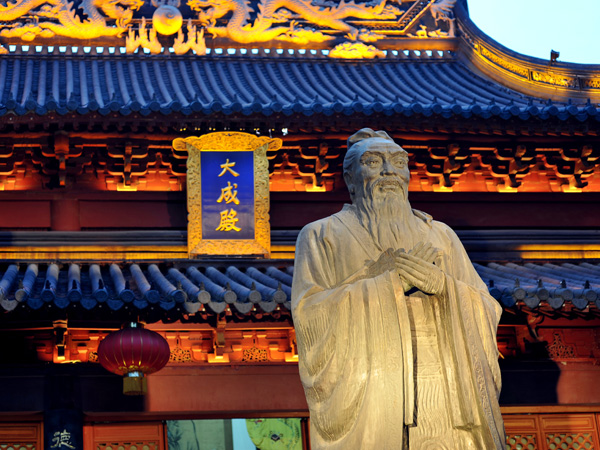
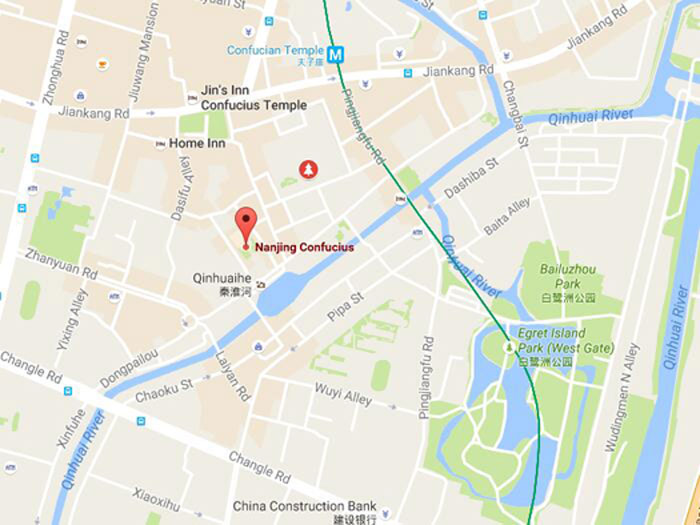
Gongyuan Street on the northern bank of the Qinhuai River, Qinhuai District, Nanjing, Jiangsu Province, China.
Large ancient architecture complex.
Located on the Northern bank of the Qinhuai River, the Confucius Temple in Nanjing is built for people to worship Confucius, a great thinker and educator in ancient China. It is one of the top four largest Confucius Temples in China. The other three are in Qufu, Jinan Province, Beijing, and Jilin Province. The temple is part of Qinhuai scenic area and become a feature of the landscape of the ancient capital of Nanjing.
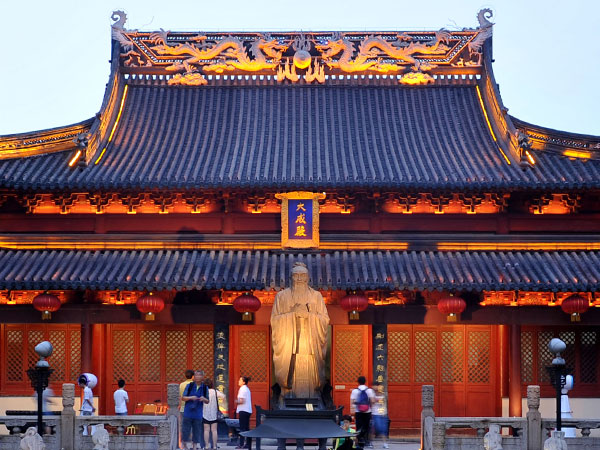
Except to get knowledge of Confucius culture here, another highlight of the temple is the buildings. Confucius Temple in Nanjing is a group of large-scale ancient buildings. The building complex is mainly composed of the Confucius Temple, Xue Gong Palace and Gong Yuan Garden. Main buildings inside the temple include Zhaobi Wall, Panchi Pool, arch, Juxing Pavilion, Kuixing Court, Lingxing Gate, Dacheng Hall, Mingde Hall, Zunjing Court and other buildings. Confucius temple is centered on Dacheng Hall, where a statue of Confucius is enshrined. Other halls and pavilions are laid out symmetrically. Qinhuai River is regarded as the companion pool of the temple. On the opposite bank of the river is an ochreous red screen wall with green tiles. With a length of 110 meters (361 feet), the wall is the longest of its kind in China. The first entrance to the temple is a tall arch 'Tian Xia Wen Shu'. The construction of both the screen wall and the arch are in an ancient architectural style used for screens and decoration.
Used to be a cultural and educational center during the Ming and Qing Dynasties, the Confucius Temple is one of the bustling areas in Nanjing with the East and West markets now. The surrounding area around the temple is one of the famous largest traditional city streets in China, together with Chenghuangmiao Temple in Shanghai (known as Old Town), Xuan Miao Guang in Suzhou and Tianqiao Bridge in. the Confucius Temple is perhaps at its best around the time of the Lantern Festival (15th day of the Chinese New Year), when a special exhibit of multi-sized and multi-colored lanterns themed around the twelve animals of the lunar cycle lend a festive air to the temple. From the first week of the Chinese New Year, Confucius Temple begins to get busier and busier until the climax of the Lantern Festival.
In the 3rd year of Xiankang Reign of Jin Dynasty (CE 337), Nanjing Imperial University was founded on the southern bank of Qinhuai River. Confucius Temple was firstly found in the national school in 384. The place was destroyed later. In 1034 during Song Dynasty, it was newly constructed on former site of the imperial university, and was renamed as Confucius Temple (Fuzimiao) to worship to Confucius (孔子, Kong Zi), arguably the most celebrated ideologist and educator in ancient China. The place became Imperial University again in 1365 during the early year of Ming Dynasty, and 16 years later recovered to be the campus of Ruxue. During Qing Dynasty, there were two Xianxue (county schools of Shangyuan and Jiangning) in Fuzimiao area. The current buildings date from the 19th century, in Qing Dynasty, with additions made since then. The temple lost all financial support by the state as a result of the revolution of 1911. During the late 1920s to 1931 and again in 1932 it was used as army barracks for troops the KMT regime and left in a dilapidated state. Some halls were used as picture gallery.
In 1985, Fuzimiao area was restored into Ming-Qing style. And the surrounding streets developed to Tourism Culture Street, offering tourist staff, local food, local folk crafts, etc.. Now it is not only a center where culture and arts thrived, but also served as a marketplace for merchants.
The Confucius Temple in Nanjing is located in the Ancient Qinhuai Block and near the Qinhuai River. The best time to explore the Confucius Temple in Nanjing depends on the scenery you prefer. The best time to visit the Confucius Temple Scenic Area is night because the night view of the Ancient Qinhuai Block is charming with the Qinhuai River, the lanterns and the lights of the shops on the street.
In spring, you can take the boat on the Qinhuai River to experience the spring of the south of the Yangtze River. In summer, you can explore the Ancient Qinhuai Block with the clear skies. In autumn, you can enjoy the autumn foliage near the Ancient Qinhuai Block with the ancient architectures. In winter, there will be less crowds at the Confucius Temple Scenic Area. And there will be lantern fairs at the Confucius Temple Scenic Area during the Spring Festival and Lantern Festival. If you want to experience the festival atmosphere at the Confucius Temple, you can visit it during the Spring Festival and Lantern Festival.
Nanjing China Imperial Examination Museum (Jiangnan Gongyuan)
Location: No.95 Gongyuan Street, Qinhuai District, Nanjing City, Jiangsu Province, China
Nanjing China Imperial Examination Museum, also known as Jiangnan Gongyuan, is a special museum that systematically reflects the imperial examination system and culture of the imperial examination in ancient China.
Based on the expansion of Jiangnan Gongyuan, the largest imperial examination room in ancient China. It consists of two parts: the southern part and the northern part. The southern part is the Nanyuan Folk Experience Zone, which displays some characteristic folk customs related to the imperial examination. The northern part consists of two parts: the underground museum exhibition area and the ground Mingyuanlou ruins area. The underground part has five exhibition areas and 33 exhibition halls. The ground part contains Ming Dynasty cultural relics Mingyuanlou, Feihong Bridge and 25 inscriptions which record the major events of Jiangnan Gongyuan in the past dynasties, with collection of more than 10,000 pieces of relics.
Jiangnan Gongyuan was the largest and most influential imperial examination room in the history of China.
There is a square pool in front of the entrance of China Imperial Examination Museum, like an inkstone. The square design embodies the principle of fairness and justice in the imperial examination. The pool covers about 1,300 square meters, which also symbolizes that the imperial examination system has lasted for 1300 years in the history of China.
Archway of Ancient Qinhuai
Archway of Ancient Qinhuai is the landmark entrance to the ancient Qinhuai Historical and Cultural Block. The Ancient Qinhuai Block embodies the prosperity of Nanjing as the ancient capital of six dynasties and metropolis of ten dynasties. It is surrounded by many historical sites such as Confucius Temple, Jiangnan Gongyuan and Qinhuai River, and it is the core area to experience the historical culture and folk customs of Nanjing.
You may take Subway Line 1 to get off at Sanshanjie Station, or take Subway Line 3 to get off at Confucius Temple Station.
From on request
From on request

 English