Your China & Yunnan Travel Experts

 Ask a Question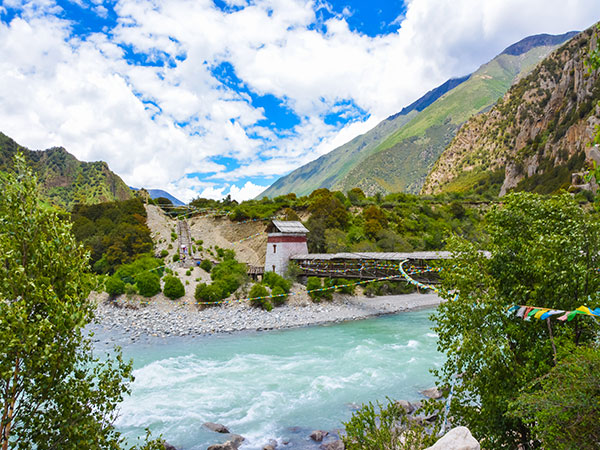
wind through the mountains of Sichuan, Yunnan and Guizhou in Southwest China.
Part of ancient Silk Road.
For thousands of years, only humans and horses treaded the mountains of Southwest China as they followed an ancient pathway through the Chinese hinterlands and the Qinghai-Tibet Plateau. Along the unpaved and rugged pathway that was formed, commodities like tea, salt and sugar flowed into Tibet. Meanwhile, horses, cows, furs, musk and other local products made their way to the outside world. The road was called the Ancient Tea-horse Road, and it stretched across more than 4,000km, mainly through Southwest China Sichuan and Yunnan and Tibet.
The Tea-Horse Ancient Road formed in the Western Han Dynasty. It starts from Yunnan and Sichuan in the east and ends in Chamdo, Tibet, which passes through the whole south-central part of Tibet to the countries in South Asia and West Asia. After thousands of years, it was gradually abandoned in modern times.
Tea Horse Ancient Road is a historical concept with a specific meaning. It refers to a traffic artery formed by the exchange of tea and horses between Han and Tibet from the Tang and Song Dynasties to the Republic of China.
Specifically, the ancient tea-horse road is mainly divided into two roads, namely, Yunnan-Tibet Section and Sichuan-Tibet Section. The Yunnan-Tibet Section starts from the tea-producing area around Erhai Lake in western Yunnan, passes through Lijiang, Zhongdian, Deqin, Mangkang and Chaya to Chamdo of Tibet. The Sichuan-Tibet Section starts from the tea-producing area in Ya 'an, Sichuan, and first enters Kangding. Since Kangding, the Sichuan-Tibet Road is divided into two branches: the northern line runs from Kangding to the north, passes through Daofu, Luhuo, Ganzi, Dege and Jiangda, reaches Chamdo, which is the northern line of Sichuan-Tibet Highway.The southern line runs from Kangding to the south, through Yajiang, Litang, Batang, Mangkang and Zuogong to Chamdo, which is the southern line of today's Sichuan-Tibet Highway.
The ancient commercial passage first appeared during the Tang Dynasty (618-907 AD). It experienced the Song, Yuan, Ming and Qing Dynasties, that is a period of more than 1,200 years. The Ancient Tea-horse Road promoted exchanges in culture and religion, and saw ethnic migration that closely resembled what was experienced on the well-known Silk Road. From ancient times, mabang (caravans) have been the main vehicles used for transportation. Year after year, thousands of caravans traveled the rough road while the hoof beats and the sounds of clear bells broke the tranquility of the canyon. The road opened a vital pathway for economics and trade with the outside world.
In World War II, this Ancient Tea-horse Road became the only transportation line for the southwest of China. Caravans transported large quantities of international assistance from India, which greatly supported China Sino-Japanese War.
After the accomplishment of the Yunan-Tibet Highway and the Chengdu-Lhasa Highway, automobiles replaced the caravans, and the Ancient Tea-horse Road became a part of history. But in the outlying mountainous area of Yunnan, caravans remain the main transportation today.
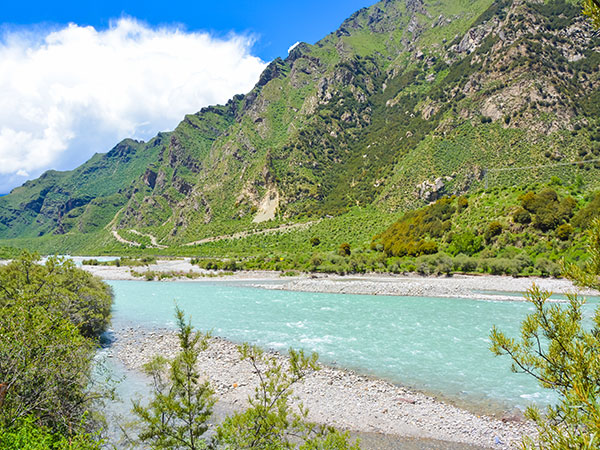
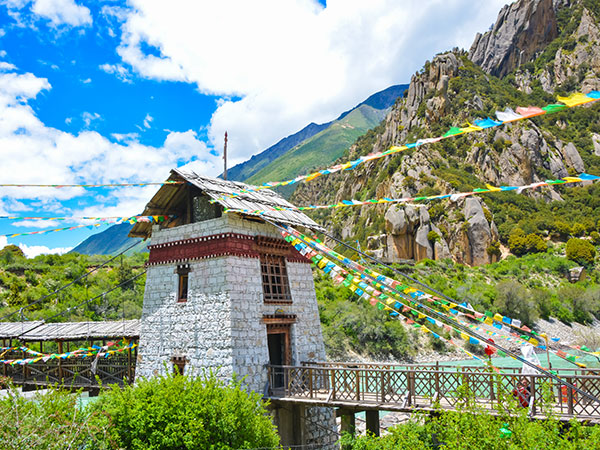
Ancient Tea-horse Road features the imposing scenery and a soul-stirring quiet. Sometimes, things seem static and the surrounding mountains stand silent. There is a kind of beauty in the desolation that may easily lead people to believe they are experienced a prehistoric place when they visit. The distant mountains reveal strong and exquisite ridges while rain and snow melt together, rushing down from the mountains and rapidly gathering before flowing into innumerable rivers. Besides mountain and rivers, there are also many peculiar stones, incomparably marvelous clouds, as well as unusual light illuminating the sky as one travels the road.
Tens of thousands of traveling horses and yaks created a definite pathway with their hooves on the once-indiscernible road. Today, although even such traces of the ancient road are fading away, its cultural and historic values remain.
Caravan is a unique mode of transportation in southwest China in ancient times, and it is also the main means of carrying the ancient Tea Horse Road. Facing the difficult environment, the caravan gradually formed its own strict organization and rules. The caravan usually consists of leader and his followers. There are cook, doctor and other persons in the caravan. The conditions of the Tea Horse Road were really difficult and dangerous in the past, each member of the caravan overcame many difficulties during their business, some of them even lost their life.
The adventure of the caravan not only challenge their fortune and life, but also test the brave and wisdom of the caravan. The special condition and environment causes the caravan culture.
Puer: home to Pu'er tea with a long history
Dali: a main processing and collection center for tea
Jianchuan: bazaar on the ancient road
Shaxi Sideng: the only surviving bazaar
Lijiang: the most famous distribution center on the road
Deqing: the last road station within the boundaries of Yunnan

 English