Your China & Yunnan Travel Experts


 Ask a Question
Xian Railway Station is the fourth largest railway station, and one of the six largest railway terminals in China. It is also one of the three station which have trains to all the provinces in China. It is located at the starting point of the Silk Road and the home town of Terracotta Warriors. As one of the 10 top grade railway station, it connects Northwest and Southwest railway network of China and get the reputation as "the First Window in West China”.
Xian Railway Station is one of the railway terminals. The construction of the main building of the station was completed in 1985. There are trains to each province and it is a very important transfer station to Northwest and Southwest of China.
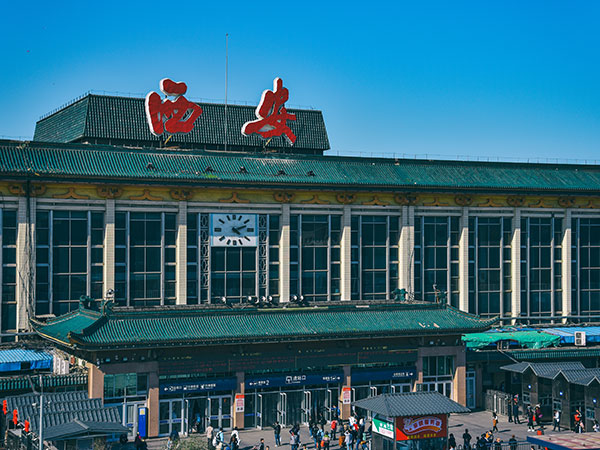
Xian Railway Station’s annual transportation capacity reaches 28,950,000. Xian Railway Terminal plays an important role in national rail network. Longhai Railway Line’s volume of freight traffic has reached 73,800,000 ton which ranks No.3 in China.
|
Name:
|
Xian Railway Station
|
| Chinese name | 西安火车站/西安站 (pronounced “Xī’ān Huǒchēzhàn”—you can show this to taxi drivers or locals if you need directions) |
|
Original Name:
|
Changan Railway Station
|
|
Construction:
|
1934
|
|
Location:
|
No. 151, Huangcheng North Road, Xincheng District, Xian City.
|
|
Lines:
|
Longhai Railway, Xikang Railway, Ningxia-Xian Railway, Xian-Shanghai Railway Station, Xihou Railway Station, Baotou-Xian Railway Station
|
A Rare Location Inside the Ancient City Wall
Xi’an Railway Station enjoys an exceptional location at the northeastern corner inside Xi’an’s ancient city wall, at the northern end of Jiefang Road. It is the only major railway station on the Chinese mainland located entirely within a fully preserved ancient city wall. For travelers, this means that the moment you exit the station, the city wall comes into view.
Where History Meets Modern Transport
The original station building dates back to 1934 and holds significant historical value. In 2016, Xi’an Railway Station underwent a large-scale renovation and expansion. Instead of replacing the old structure, the project carefully integrated the historic building with new station facilities, allowing the past and present to coexist within the same complex. Today, Xi’an Railway Station functions as a modern, comprehensive transportation hub, combining:
Main Function Within the Xi’an Railway Network
In terms of operation, Xi’an Railway Station mainly serves conventional (non–high-speed) trains, while also handling some D-series trains on routes within Shaanxi Province and to neighboring provinces. Within the overall planning of the Xi’an railway hub, often described as a “four main stations plus one auxiliary station” structure, Xi’an Railway Station plays the role of the auxiliary passenger station. Its primary responsibility is to share the load of conventional rail transport, allowing high-speed services to be concentrated at other stations.
Xian Railway Station was first built in Dec., 1934, and officially operated in June, 1935.
In 1937, it changed its name to Changan Railway Station. In 1952, its name changed back to Xian Railway Station again.
In 1984, it began the reconstruction project. On Dec. 31st, 1985, the main building finished construction.
In 1988, the station upgrade to top grade station from the frist class station.
In Oct. 1st , 1990, the Ticket office and the office building was completed the construction, and the whole reconstruction project was completed. There are Ticket Hall, Waiting Hall, Package Hall and supporting facilities such as restaurants, tourism services. Waiting Hall has east and west Allocation Halls, normal waiting room, infant & mom waiting room, soft sleeper waiting room and other room which are all together 12 wairing rooms with the capacity of 7000 people. The Ticket Hall is at the east part of the Waiting Building. There are 60 ticket windows. And there are 84 Train ticket booking points in the city.
2021-2025: The station underwent another round of upgrading and expansion. In January 2021, the South Station Building’s central hall and waiting rooms were put into use; in September 2025, the South Station Building and South Elevated Waiting Hall were officially opened, marking the full connection of the North and South Station Buildings. The upgraded station has a more spacious layout, with the waiting area increased to over 80,000 square meters and the number of platforms expanded from 6 platforms and 9 tracks to 9 platforms and 18 tracks.
Following its large-scale renovation and expansion (completed in phases, with the north square fully operational in 2021), Xi'an Railway Station has transformed into a modern integrated transport hub with a "North-South Through, Dual Squares, Dual Buildings, Dual Metro Access" layout.
| Area | Characteristics & Functions | Transport Connections |
| South Square & South Building | Facing the ancient city wall, serving as the historical and cultural gateway. | • Metro: Lines 4 & 7 (planned) at "Xi'an Railway Station" stop, providing direct access to the square. |
| • The exterior retains historical architectural elements, harmonizing with the ancient city wall (Danfeng Gate). | • Public Bus: Major bus hub with numerous routes. | |
| • Main entrance, typically handling the highest passenger volume. | • Taxi/Ride-hailing: Designated pick-up zones. | |
| North Square & North Building | Facing the Daming Palace ruins, functioning as the modern transport nexus. | • Metro: North concourse of Line 4 "Xi'an Railway Station" stop. |
| • Brand new (2021), featuring modern and expansive architecture. | • Public Bus: Bus stops available. | |
| • Primarily serves as the main exit, significantly improving passenger flow distribution. | • Taxi/Ride-hailing: Designated pick-up zones. | |
| • Connected to the South Square via an underground passage. | • Intercity Coach: Close to Shaanxi Province Xi'an Bus Terminal. | |
| Elevated Waiting Hall | The core connector between the North and South Buildings. | |
| • Spans above the railway tracks, fully integrating north and south. | ||
| • Passengers enter from either the South or North entrance to reach this unified waiting hall, then proceed to the corresponding boarding gate. | ||
| Danfeng Gate Square | A super underground transport interchange. | |
| • The ground level is a grand historical-cultural plaza facing the Daming Palace Danfeng Gate site. | ||
| • Its three underground levels create a multi-layer system that separates buses, taxis, private cars, and metro passenger flows ("pedestrian-vehicle separation"), ensuring order and efficiency. |
Entering the Station and Boarding Your Train
At present, passengers can enter Xi’an Railway Station through either the South Square or the North Square, both of which lead directly to the elevated waiting hall. You can simply choose the entrance that is more convenient based on your direction of arrival.
If you are taking the metro, you can ride Metro Line 4 to “Xi’an Railway Station”. By following the station signs, you can walk directly into the South or North station entrances, avoiding surface traffic altogether. This makes metro travel one of the fastest and most reliable ways to reach the station, especially during rush hours.
Exiting the Station and Making Transfers
After your train arrives, passengers usually exit through underground passages. From there, you can choose between the South Exit or the North Exit, depending on your next destination.
Which Exit Should You Choose? Use the South Exit if you are heading toward:
Use the North Exit if you are going to:
Metro access is right next to the exit passageways. Simply follow the “Metro” signs, and you will quickly reach the Metro Line 4 station hall.
Key Transport Connections from Xi’an Railway Station
Metro: Metro Line 4 is the main transport artery connecting Xi’an Railway Station with Xi’an North Railway Station (the high-speed rail hub). It is also one of the most convenient lines for reaching major attractions such as the Big Wild Goose Pagoda and Tang Paradise.
City Buses: Both the South Square and North Square feature large bus hubs, with routes covering most parts of the city. Buses are a budget-friendly option, though they can be slower during peak hours.
Taxis and Ride-Hailing: Designated taxi and ride-hailing pick-up areas are available at both squares. Follow the signs or ask station staff to find the correct pick-up zone, and make sure to board vehicles only from the official areas.
► More transportation information: Xian Transportation
► More travel information: Xian Travel Guide

 English