Your China & Yunnan Travel Experts


 Ask a Question
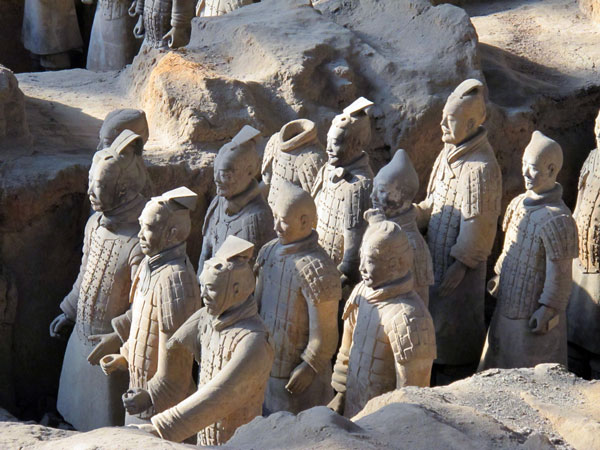
At the apex of this clay hierarchy are the commanding officers, whose authority is conveyed through distinctive attire, posture, and bearing.
Senior General (高级将军): These are the rarest and most impressive figures, with fewer than 10 excavated to date. They are subdivided into two types:
The highest-ranking officers. They wear intricate, layered fish-scale armor adorned with eight ornamental knots or tassels (花结) on the chest, back, and shoulders. Their headgear is the distinct double-tailed "He Guan" (鹖冠), often depicted as a pheasant-tailed helmet, symbolizing valor and high command. They stand tall (around 1.96 meters), with a powerful, dignified stance, hands resting calmly on a sword or clasped before them, exuding strategic authority.
Slightly less ornate but no less commanding. They wear long, elegant war robes over their armor, fastened with a belt and often featuring a single, prominent decorative cockade on the chest. Their authority comes from their imposing physical presence and calm, observant posture.
Middle & Junior Military Officers (中下级军吏): These officers form the crucial link between generals and troops. They can be identified by their headgear—either a single-tailed "Chang Guan" (长冠) or simpler caps—and more detailed armor than common soldiers. Their gestures are often dynamic, pointing or gesturing as if directing troop movements or issuing orders on the battlefield.
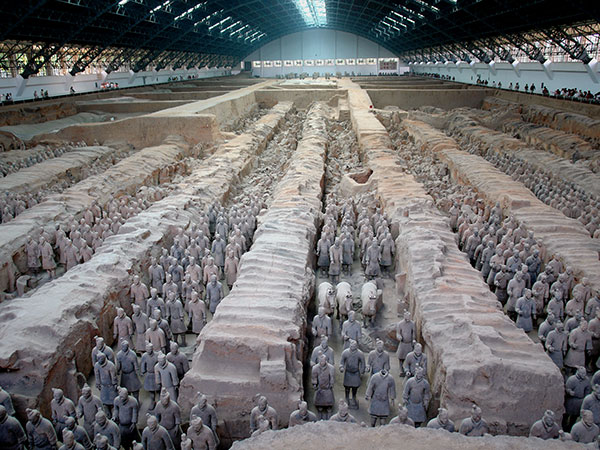
The bulk of the army consists of versatile infantry and specialized combat units, each with a defined tactical purpose.
Armored Infantryman (铠甲武士)
The backbone of the Qin phalanx. These warriors wear heavy, rectangular plate armor made of small stone or leather plates laced together, covering the torso and shoulders. They stand in the core of formations, armed primarily with long spears (丈八矛), halberds (戟), or swords. Their faces show a mix of determined expressions, reflecting their role as the main line of offense and defense.
Unarmored Infantryman (战袍武士)
These soldiers wear long, knee-length battle tunics without heavy torso armor, allowing for greater agility. They are typically positioned on the flanks or outer ranks of formations. Their lighter dress suggests roles that required rapid movement, such as skirmishing, supporting the armored core, or exploiting breakthroughs.
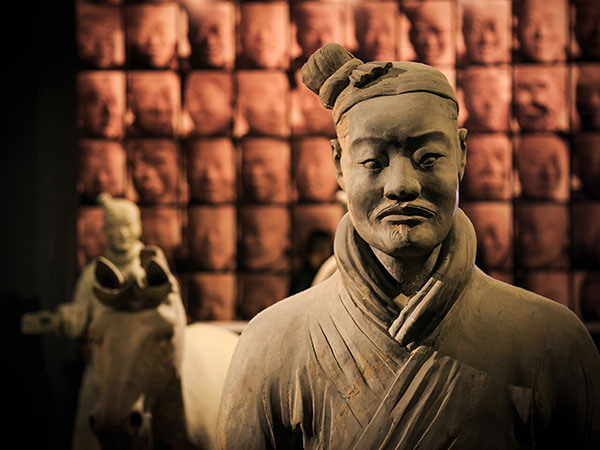
Standing Archer (立射俑):
A masterpiece of dynamic realism. Unearthed primarily from Pit 2, these figures capture the moment of preparing to shoot. They stand with feet in an "L" shape (left foot forward, right foot perpendicular), twisting their torso. Their left arm is extended as if holding a large crossbow, while the right hand is drawn back near the cheek in the precise gesture of "holding a baby," as described in ancient texts. They wear light, flexible armor and their hair is intricately tied in a topknot. They formed the outer, mobile ring of crossbow formations.
Kneeling Archer (跪射俑):
Found alongside standing archers, they form the stable, reloading core of the crossbow units. In a perfectly balanced kneeling posture (right knee down, left knee raised), they appear ready to shoot or reload their powerful crossbows. The detail is extraordinary, down to the stitching patterns on the soles of their square-toed shoes. Their presence demonstrates the Qin army's mastery of combined-arms tactics and volley fire.
The Qin military's sophistication is further shown by its dedicated cavalry and charioteers.
Terracotta Cavalryman & Horse (骑兵俑)
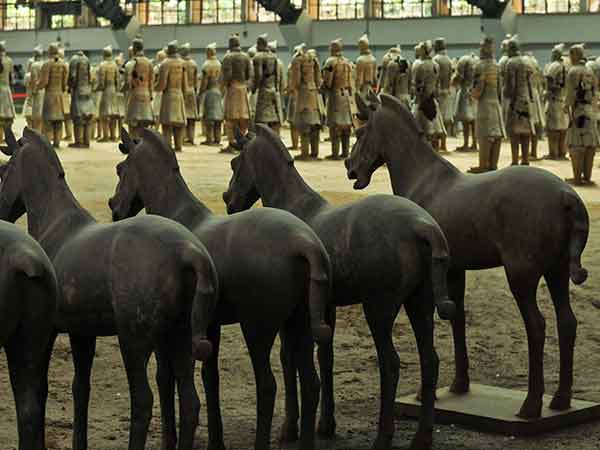
Among the most historically significant finds are the 116 cavalry figures from Pits 1 and 2, representing the earliest known cavalry models in Chinese history. The riders are distinctly outfitted for speed and mobility: short, lightweight armored vests, tight-sleeved robes, flexible trousers tucked into ankle boots, and a unique rounded, hat-like helmet that fits snugly. They stand beside their saddled horses, one hand holding the reins, the other poised as if to wield a bow or a sword. The horses themselves are alert and muscular, ready for action.
Charioteer (御手俑)
The drivers of the powerful Qin war chariots held a position of great responsibility and skill. They are heavily armored for protection, wearing long armor that extends over the shoulders, high neck protection, and forearm guards. Their most distinctive feature is their unique, pillbox-shaped headgear, fastened securely under the chin. Their arms are always extended forward in a careful, controlled gesture, holding imaginary reins. Their concentrated expressions convey the focus required to maneuver a two- or four-horse chariot in the heat of battle.
Chariot Sergeant (车士俑)
Positioned on either side of the chariot, these warriors protected the vehicle and its driver. They are armed with long-range weapons like spears or halberds. Their role was both offensive and defensive, fending off attackers and striking at enemy formations from the mobile platform of the chariot.
Beyond these main types, archaeologists have also identified figures representing musicians, acrobats, and strongmen in nearby pits, suggesting a complete subterranean court. Furthermore, the weapons they held—originally real, functional bronze items like swords, arrowheads, and crossbow triggers—were engineered with advanced techniques like chromium plating to prevent rust.
The staggering variety of the Terracotta Warriors is their true wonder. Each type, from the general to the archer, was created from separate molds for body parts, which were then assembled and individually sculpted with unique facial features, hairstyles, and expressions. This was not a mass-produced art project but a deliberate, systematic creation of an eternal imperial guard, reflecting the Qin Dynasty's unparalleled military organization, logistical prowess, and belief in power extending beyond the grave. To walk among them is to witness a frozen moment of history, where every figure has a story, a rank, and a purpose in the First Emperor's quest for immortality.

 English