Your China & Yunnan Travel Experts


 Ask a Question
As a crucial transportation hub in the Yangtze River Delta, Suzhou boasts an extensive railway network that connects it to major cities across China. With a total of 15 railway and high-speed railway stations (14 already in operation and 1 under construction) , the city's transportation system caters to both local commuters and international tourists. Among these stations, those in downtown Suzhou—including Suzhou Railway Station, Suzhou North Railway Station, Suzhou Industrial Park Railway Station, and Suzhou New District Railway Station—serve as the core hubs, offering convenient access to scenic spots, business districts, and residential areas. This guide provides detailed information on all of Suzhou's stations, with a focus on downtown hubs and practical travel tips for visitors, concluding with a comparative analysis to help you choose the most suitable station for your trip.
Suzhou's railway network covers 15 stations in total, with 7 located in downtown areas and 8 in county-level cities . The downtown stations are Suzhou Railway Station, Suzhou North Railway Station, Suzhou Industrial Park Railway Station (Suzhou Yuanqu Station), Suzhou New District Railway Station (Suzhou Xinqu Station), Suzhou East Railway Station (under construction), Suzhou South Railway Station, and Shengze Station. The county-level stations include Zhangjiagang Station, Changshu Station, Changshu West Station (under construction), Taicang Station, Taicang South Station, Kunshan South Station, Kunshan Station, and Yangcheng Lake Station . While downtown stations are the focus of this guide due to their central location and frequent services, a brief introduction to county-level stations is also provided for reference.
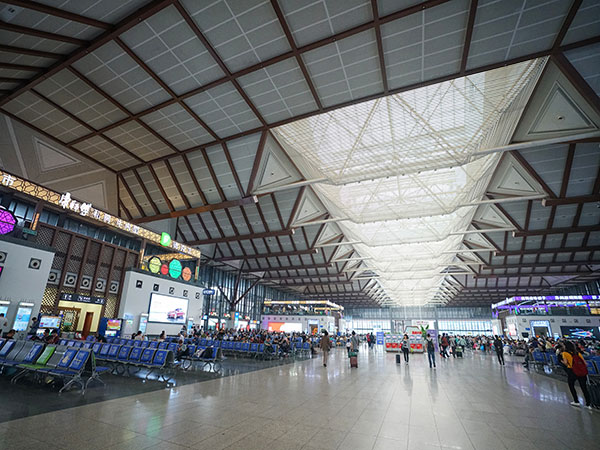
Suzhou Railway Station adopts an elevated waiting room design, integrating north and south waiting areas with the elevated station building . The main station building has five floors in total: two above ground and three underground . The ground floors house ticket offices, security checkpoints, and entrance/exit halls, while the elevated floor serves as the main waiting area, offering clear views of the platform area. The three underground floors are dedicated to rail transit and pedestrian passageways: the second underground floor is the transfer hub for Suzhou Rail Transit Line 2 and Line 4, providing seamless connection to the city's metro network.
The station features two squares: South Square and North Square . The South Square, officially opened on February 5, 2013, is a cultural landmark in itself. It houses a large stone relief map of Pingjiang Ancient Town and sculptures of Suzhou's renowned historical figures, including Fan Zhongyan, Yan Yan, Tai Bo, Sun Wu, and Bai Juyi . These artworks showcase Suzhou's profound cultural heritage, making the square a popular photo spot for visitors upon arrival. The North Square, on the other hand, focuses on transportation convenience, serving as a hub for buses, taxis, and ride-hailing services .
- Metro: The most convenient way to travel around the city. Line 2 connects the station to scenic spots such as Shantang Street and Tiger Hill, while Line 4 provides access to Humble Administrator's Garden and Suzhou Museum. The metro station is directly accessible from the second underground floor of the station, with clear signage guiding passengers.
- Bus: The bus routes have been optimized to enhance convenience. Lines to Industrial Park and Xiangcheng District are concentrated at the North Square Bus Hub, while routes to New District and Gusu District are at the South Square Bus Hub . Key lines include No. 1, 26, 38, 119, 178, 518, 6, 7, 40, 44, 81, 82, and 91, covering major scenic spots and commercial areas .
- Taxi/Ride-Hailing: The ride-hailing pickup point is located at the East Hub of the North Square Bus Station. After exiting through the underground passage, passengers can take the escalator to the square and reach the pickup area in less than 2 minutes . Taxis are available at designated stands in both South and North Squares.
With a history spanning over a century, Suzhou Railway Station was first built in 1906 during the late Qing Dynasty with funding from the local Suzhou government and officially opened in 1908 . The original station building covered a mere 205 square meters and was severely damaged during the Sino-Japanese War, undergoing repairs in 1941 . After the founding of the People's Republic of China, the station was expanded to 1,400 square meters. The current station building was constructed in April 1979 and put into use on June 1, 1982, upgrading to a first-class station and becoming the largest railway station in Jiangsu Province at that time . Today, it blends century-old history with modern transportation functions, serving as a symbol of Suzhou's integration of tradition and modernity.
As the busiest station in Suzhou, especially popular among tourists visiting the ancient city, it is recommended to arrive at least 1 hour earlier during weekends and holidays to avoid delays due to long security checks . The station is within walking distance (20 minutes) to Suzhou Silk Museum. For those planning to visit classical gardens such as Humble Administrator's Garden, Lion Grove, and Pingjiang Road, staying near Guanqian Street is highly recommended.
Suzhou Railway Station was built in 1906 during the early Qing Dynasty, funded by the local government of Suzhou. It was formally put into use in 1908. Station house covered an area of only 205 square meters at that time, the site two. During the Sino-Japanese War, the station had been seriously damaged and was repaired until 1941. After the liberation, the main area of Suzhou Station expanded to 1,400 square meters. Suzhou Railway Station used today was built from April 1979. On June 1, 1982, it was put into use. The new station house has a capacity of maximum 5,000 people. It was promoted to first-class station after the new station was used. It was extended to 7 platforms and 16 rail lines, which made it the largest train station in Jiangsu.
►More transportation information: Suzhou Transportation
►More travel information: Suzhou Travel Guide

 English