Your China & Yunnan Travel Experts


 Ask a Question
Kunming, the storied "Spring City," is a living testament to the profound history of Yunnan and a pivotal bridge between the Chinese heartland and the civilizations of Southeast Asia. With a recorded urban history spanning over 2,400 years, Kunming’s enduring significance stems from its strategic location. It has long served as the northern gateway to the legendary South Silk Road (also known as the Sichuan-India or Tea-Horse Road), a network of caravan trails that facilitated the exchange of goods, ideas, and cultures between the empires of Central China and the kingdoms of Tibet, Burma, and India.
The region’s deep history begins far earlier. Archaeological discoveries, such as the ancient human fossils in the Chenggong Longtan Mountain area, reveal that the fertile shores of Dianchi Lake were inhabited as early as 30,000 years ago during the Paleolithic Age, marking it as a significant cradle of early human activity in Southwest China.
Kunming’s emergence as a political center occurred in the 3rd century BC during the Warring States Period. According to the Han historian Sima Qian, a Chu general named Zhuang Qiao led a military expedition into the region. Cut off from returning home by the Qin conquest of Chu, he and his soldiers settled around Dianchi Lake, intermarried with the local indigenous tribes, and established the Kingdom of Dian. Its capital was believed to be in present-day Jinning, south of Dianchi. This sophisticated bronze-age civilization, lasting over 200 years, is renowned for its breathtaking bronze artifacts excavated from sites like the Shizhaishan Tombs, featuring intricate cowrie-shell storage vessels, vivid scenes of ritual and warfare, and the iconic Dian Drum, all of which speak of a unique, complex society. Kunming today stands as a guardian of this ancient capital's legacy.
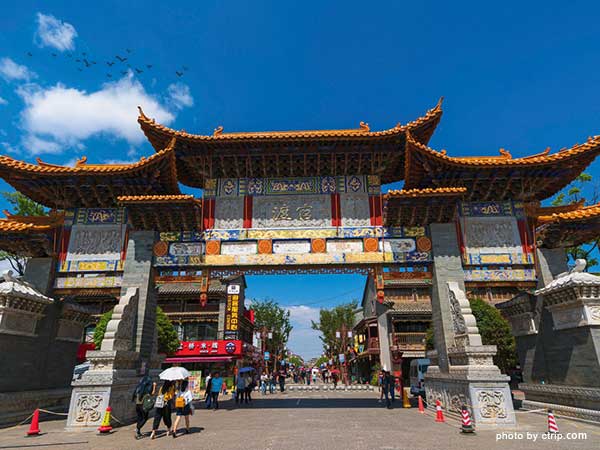
The Dian Kingdom’s independence ended in 109 BC when Emperor Wu of the Western Han Dynasty, as part of his great southwestern expansion, sent armies to conquer the region. The Han established Yizhou Commandery in the Dianchi area, with Guchang County (located in modern-day Kunming) as one of its 24 constituent counties. This marked Kunming’s formal incorporation into the Chinese imperial administrative system and cemented its role as a Han frontier garrison and trade node.
In the centuries that followed, the area experienced successive waves of rule. During the Three Kingdoms period, the Shu Han chancellor Zhuge Liang pacified the region in his southern campaigns. By the time of the Tang Dynasty (618-907 AD), the geopolitical landscape shifted dramatically with the rise of powerful local kingdoms. The area fell under the control of the Nanzhao Kingdom (738-902 AD), which constructed the Eastern Capital (Dongdu) at Tuodong, on the northern shores of Dianchi Lake. This laid the physical and administrative groundwork for Kunming’s later prominence. After Nanzhao’s collapse, the succeeding Dali Kingdom (937-1253 AD) continued to govern the region, establishing the Shanzhan City fortress. Throughout this medieval period, Kunming was a crucial military and commercial center, thriving on the trade of tea, horses, salt, and silver along the expanding southern Silk Road network.
A transformative moment in Kunming’s history arrived with the Mongol conquest. In 1253, Kublai Khan’s forces captured the Dali Kingdom. By 1275, the Yuan Dynasty established Yunnan Province—one of China’s earliest provincial-level administrations—and moved its political and military center from Dali to Kunming. The city was designated the seat of Kunming County, becoming the province’s undisputed political, economic, and cultural capital, a status it has maintained for over 700 years.
The Ming Dynasty (1368-1644) solidified this status. In 1381, Ming armies took Yunnan and extensively rebuilt the city. They constructed substantial stone city walls in a nearly square layout, erected key landmarks like the Golden Temple (Ming-era bronze hall), and massively promoted Han Chinese migration through military-agricultural colonies (tuntian), profoundly reshaping the region’s demographics and culture. The city was renamed Yunnan Prefecture.
The Qing Dynasty (1644-1912) inherited and developed the Ming framework. The mid-17th century was a turbulent interlude: as the Qing captured Beijing, remnants of the peasant rebel army led by Zhang Xianzhong retreated to Yunnan. His general, Sun Kewang, and later, the last claimant of the Southern Ming Dynasty, Zhu Youlang (the Yongli Emperor), used Kunming as a resistance capital until the Qing finally consolidated control in 1659. Throughout the Qing era, Kunming remained the provincial seat, with the famous Daguan Pavilion rebuilt in 1690. By the late 19th century, the city faced a new external force: French Indochina. The 1885 Sino-French War and subsequent treaties opened Yunnan to French influence. The Kunming-Haiphong Railway, completed in 1910, connected Kunming directly to the sea in Vietnam, injecting a new, modernizing but colonial, dynamic into the ancient city.
The modern era began with the "Chongjiu Uprising" (Double Ninth Uprising) on October 30, 1911, where revolutionary forces in Kunming successfully overthrew Qing rule in Yunnan, making it one of the first provinces to support the Xinhai Revolution.
The city was formally established as a municipality in 1928. Its most defining modern trial came during the Second Sino-Japanese War (1937-1945). Following the fall of coastal China, Kunming became a vital wartime capital in the rear. It served as the terminus for the heroic Burma Road and the perilous "Hump" airlift, making it the crucial lifeline for international Allied aid into China. This period also witnessed an extraordinary intellectual migration, with prestigious institutions like Peking University, Tsinghua University, and Nankai University relocating to form the National Southwestern Associated University (Lianda) in Kunming. This confluence of scholars, soldiers, and aviators transformed the city into a vibrant, cosmopolitan center of resistance, learning, and international exchange.
In December 1949, Kunming was peacefully liberated. Post-1949, especially after the Reform and Opening-up policies, the city entered a phase of accelerated development. Today, as the capital of Yunnan Province, Kunming is a thriving national central city, a hub for China’s "Belt and Road Initiative" (particularly the China-Indochina Peninsula Economic Corridor), and a world-class gateway to Southeast and South Asia. It hosts major international events, boasts a sophisticated transportation network, and is a leader in eco-tourism, horticulture (showcased by the 1999 International Horticultural Exposition), and high-tech industries.
From the bronze masters of Dian to the scholars of Lianda, from a Silk Road caravan stop to a 21st-century transnational hub, Kunming’s history is a continuous narrative of adaptation, synthesis, and pivotal importance—a city that has perpetually served as China’s springboard to the rich and diverse worlds to its south.

 English