Your China & Yunnan Travel Experts

 Ask a Question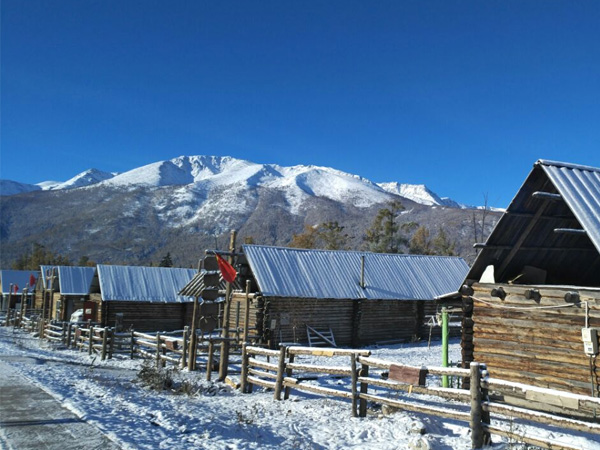


 In the distant Burqin County, Xinjiang Altai Kanas Lake district, home to about 2000 Tuwas. Tuwa people carry on the traditional way of life as before. Tuwa Village located between two mountains, a narrow valley just for so more than 80 people to live. It seems to be wide, because the mountain is not high, and therefore the valley village also appears serene. Behind the Village is hill, the top of the hill is snow. During the summer, snow peak is covered by light green forest. Accompanying by the afterglow, cabin with spire, Swiss style in Tuwa Village reflected a little bit warm golden glow. Cabin next to the pine trees spread scatteredly, all are tall and straight. In the village there are white birchs, scatter in the middle of the pine tree, and because of white stems, they are very conspicuous, combined with booming canopy make they like big umbrella. Behind Tuwa village is the Friendship Peak on the border between China and Russia, with Siberia wind blowing from Friendship Peak and as the terrain becomes lower with the sudden warming to breed the thick trees.
Suitable Travelers:Boutin-Toua Village is best suited for travelers interested in ethnic minority cultures, traditional lifestyles, and natural environments—particularly those who appreciate a slower pace and enjoy observing details. If you seek well-developed facilities, diverse activities, or striking visual experiences, this destination may not meet your expectations. However, for visitors hoping to witness authentic village life and understand the relationship between people and nature, it is a place worthy of serious consideration.
Buqintuwa Village is compact in scale, with dwellings predominantly constructed of wood or a combination of wood and stone. Their appearance is simple and unadorned, featuring colors close to natural hues with minimal use of bright decorations. The houses are spaced widely apart, interspersed with grassy areas, wooden fences, and living spaces. This layout prevents the village from appearing densely packed, instead allowing it to blend seamlessly into the natural surroundings.
The village is typically surrounded by gently sloping grasslands and scattered woodlands, where cattle and sheep roam freely near the settlement. Boundaries between human and livestock areas are not strictly defined. Village roads are mostly dirt paths or simple paved surfaces, allowing one to distinctly feel the undulating terrain and natural texture beneathfoot. The overall environment is quiet, devoid of persistent background noise. The sounds of wind, livestock, and occasional conversation form the village's primary “soundscape.”
In Buchintouwa Village, what truly merits attention isn't any single marked attraction, but rather the way of life and spatial relationships embodied by the entire settlement. Most wooden houses retain their original, functional forms. Their exterior walls bear natural hues without artificial adornment. Firewood, farm tools, and daily necessities are often stacked haphazardly before and behind dwellings. These seemingly casual details actually document how locals adapt to climate and daily needs.
Walking along the dirt paths, you'll see livestock moving freely between houses. Cattle and sheep aren't strictly penned in but coexist within human living spaces. The boundaries between fences, pastures, and residential areas are indistinct, a layout reflecting the Tuvan people's long-established semi-nomadic lifestyle. Viewed from a slightly elevated vantage point, the village appears naturally embraced by meadows, forests, and hillsides, with scarcely any jarring artificial traces. The settlement as a whole seems seamlessly embedded within the natural landscape.
Beyond the village itself, the surrounding natural environment is equally significant. The grasslands, rivers, and woodlands extending beyond the village are inextricably linked to village life, with no clear dividing lines. Walking along the village's edges reveals grazing paths, watering spots, and traces left by livestock—all integral parts of the village's daily operations. These details offer a vivid understanding of the interdependent relationship between the local residents and their natural surroundings.
At the right time, visitors may also witness Tuva people herding livestock, organizing tools, or handling daily affairs. These activities are not staged performances for tourists but organic fragments of life—precisely the most valuable “viewing content” of Buchintuwa Village. By observing these authentic, uncontrived details, the culture and way of life embodied by Buchintuwa Village gradually become clear and tangible.
The best time to visit Buchintuva village is from June to September each year. During this period, the grasslands are lush, the climate is relatively mild, road conditions are good, and the natural scenery surrounding the village is at its most abundant. Autumn offers distinct color layers and a tranquil atmosphere, making it a great time to photograph the village and natural landscape. Winter is cold and transportation is inconvenient, so it is generally not recommended for ordinary tourists.
Accommodation and dining in Buchintuwa Village are relatively basic, primarily offered through homestays that emphasize experience over comfort. Meals consist mainly of local home-cooked dishes, featuring common ingredients like beef, mutton, dairy products, and simple staples. Flavors tend to be simple and unadorned, prepared in straightforward ways. Accommodations typically lack comprehensive modern amenities but allow visitors to immerse themselves more deeply in the local environment.
For those prioritizing comfort, consider staying in Habahe County township. This allows daytime visits to Buchintuwa Village while returning to the county township for overnight rest. This approach ensures an authentic experience while maintaining quality rest.
From $ 521

From on request
From on request

 English