Your China & Yunnan Travel Experts

 Ask a Question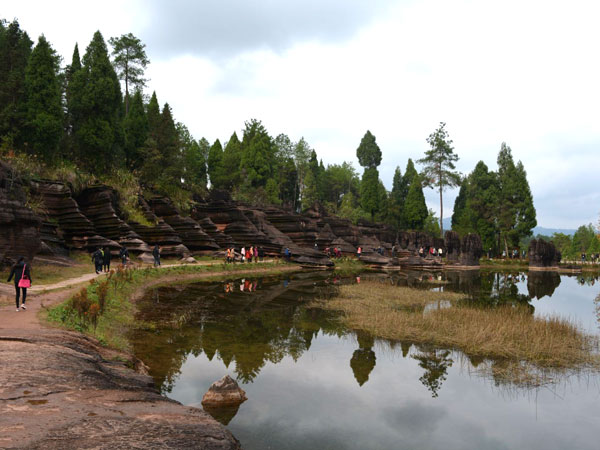
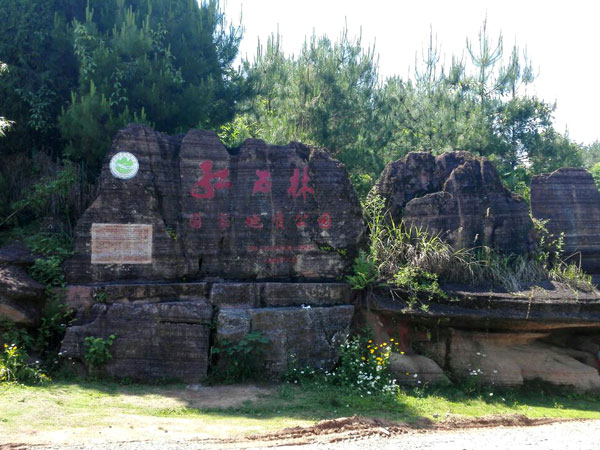
Hongshilin Town, Guzhang County, Xiangxi Tujia and Miao Autonomous Prefecture, Hunan province, China
China's only red carbonate stone forest
Red Stone Forest National Geological Park (Chinese name: 红石林国家地质公园) is located in Guzhang County in Xiangxi Tujia and Miao Autonomous Prefecture in the west of Hunan Province. It faces the beautiful Furong Ancient Town on the other bank of Youshui River, and is sited on the way between Zhangjiajie and Fenghuang Ancient Town. So you can add Furong Ancient Town and Red Stone Forest National Geological Park into your itinerary if you travel from Zhangjiajie to Fenghuang or vice versa. It is the only carbonate stone forest in red found so far in China. Other stone forests in China are usually in gray color.
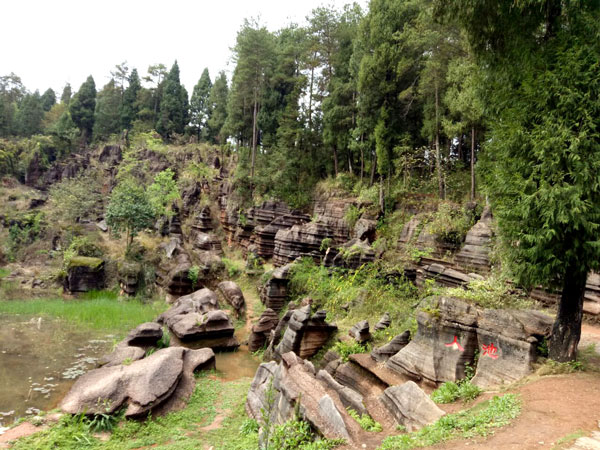
According to the geological experts’ research, the formation of the red stone forest can traced back to about 450 million years ago. The red stone forest used to be a seabed during Ordovician period. Here deposited a large amount of shaly sand with carbonate material. With millions years of erosion and corrosion by rain and sea water later and crustal movement, it formed unique Karst landform that we can see today. For the rock contains rich iron element, it presents the color in red.
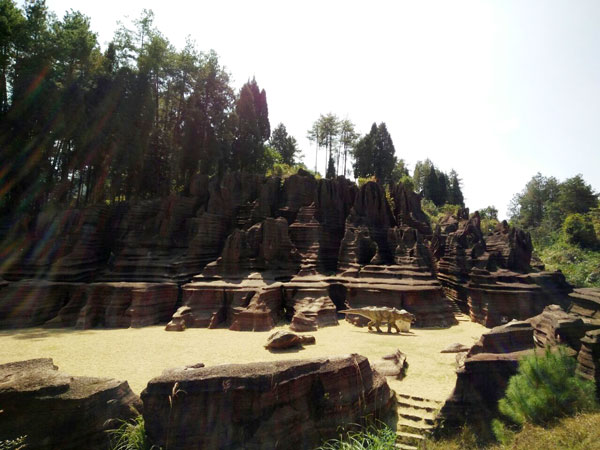
The stone forest covers an area of 20 square kilometers in a totally original ecological status. In the stone forest, there are valleys, stream and springs. There are thick grassland and wistaria flowers growing in the forest, making it like a garden of nature. The tall rocks in various shapes can be seen throughout scenic spot. The stone color is changeable in accordance with the weather, time and season. The stone is red in Sunny days, black in the rain, brown and red on cloudy days. It even presents different colors in the morning and evening in a day.
If you come from Zhangjiajie, you may take a bus at Zhangjiajie Central Bus Station (near to Zhangjiajie Railway Station) to reach Red Stone Forest Tourist Center in Furong Town first. The buses run every one hour from 7:00am to 5:00pm and take about 2 hours. Then rent a minibus or motorcycle to take you to the entrance of Red Stone Forest National Geological Park, which takes 20 minutes.
If you come from Jishou City, you may take bus at Jishou Xikou Bus Station to reach Wangcun Bus Station(王村汽车站 in Chinese) first. The buses departs every 30 minutes from 8:30am to 6:30pm and takes about 1 hours. Then walk to Red Stone Forest Tourist Center in Furong Town to rent a minibus or motorcycle to take you to the entrance of Red Stone Forest National Geological Park, which takes 20 minutes.
The park is composed of four major scenic areas: Red Stone Forest Scenic Area, Zuo Long Gorge Scenic Area, Qifeng Lake Scenic Area, and the “Golden Nail” Protection Zone. Among them, the Red Stone Forest Scenic Area is the core and most visited part of the park.
The Red Stone Forest Scenic Area consists of two main sections: Qietong and Duanlong. It mainly features the spectacular red stone forest landscape, complemented by underground karst caves. The name “Red Stone Forest” comes from the dense clusters of towering red stone pillars that resemble a vast forest made of stone. Within an area of about 30 square kilometers, over 1,000 red stone pillars have developed, with heights ranging from 10 to more than 30 meters. These stone pillars come in various forms and shapes, creating a stunning display of natural art and geological diversity.
Notable attractions in this area include the Ancient Yangtze Sea, Heavenly Pool, Earthly Pool, Human Pool, Ordovician Seabed, Xiaolong Gorge, Water Flooding Golden Stone, Flower Hill, Baishou Square, Lucky Gate, and Treasure Meadow. There are also underground caves, sheer cliffs, sinkholes, and ancient trees that are thousands of years old. The entire scenic area combines the beauty of redness, elegance, steepness, mystery, rarity, and antiquity. As you step into the stone forest, you’ll find yourself surrounded by marvelous rock formations and breathtaking views, as if wandering through a gigantic natural stone sculpture museum.
Zuo Long Gorge, another scenic part of the park, is characterized by its dramatic canyon landscape. The gorge stretches about 6.5 kilometers, with a core section of 3.5 kilometers. The highest elevation reaches 760 meters, while the lowest point drops to 320 meters, with an average depth of 80 meters and the deepest part exceeding 100 meters. The width of the valley floor ranges from 4 to 10 meters, narrowing to a point where only one person can pass.
The gorge showcases distinctive thin, medium, and thick-bedded limestones, with horizontal stratification as well as visible fault, joint, and fold structures. These geological formations not only create a visually impressive natural landscape but also hold great scientific value for research and education. Walking through Zuo Long Gorge allows visitors to appreciate both the aesthetic beauty and geological significance of this natural wonder.

11 Days Beijing-Xi'an-Zhangjiajie-Shanghai Group Tour
Beijing, Xi'an, Zhangjiajie, Shanghai
Qifeng Lake Scenic Area is located in the northern part of Guzhang County along the Youshui River. It is the largest man-made lake in the Youshui River Basin, covering a total area of about 53,000 mu (approximately 35 square kilometers), including 20,000 mu (13 square kilometers) of water surface. The lake’s average water depth remains over 30 meters throughout the year, and its surface elevation is around 200–205 meters. It was formed after the construction of the Fengtan Hydropower Station, which raised the water level to create this beautiful reservoir.
The lake contains 19 islands and 21 peninsulas, receiving water from 17 surrounding mountain streams. The outer lake is broad, while the inner lake winds gracefully among the hills, forming a layered and varied landscape. With its striking mountain formations, crystal-clear water, and rich local Tujia and Miao ethnic culture, Qifeng Lake is an ideal destination for sightseeing, archaeology, scientific research, and vacationing.
The “Golden Nail” Protection Zone (Jindingzi) refers to the internationally recognized stratotype section and point of the Cambrian Guzhangian Stage. It is located in Luoyixi Town, Guzhang County, on the right bank of the Youshui River. In March 2008, the International Commission on Stratigraphy approved this proposal unanimously, and the Secretary-General of the International Union of Geological Sciences, Bobrovsky, officially signed the certification.
Since then, the “Golden Nail” of the Cambrian Guzhangian Stage has been formally established in China. It is the sixth “Golden Nail” named after a Chinese locality and the ninth one within China’s territory. This site is a geological relic of exceptional scientific and historical value, playing a crucial role in global stratigraphic studies and the understanding of Earth’s evolutionary history.
From $ 451
From $ 438

 English