Your China & Yunnan Travel Experts

 Ask a Question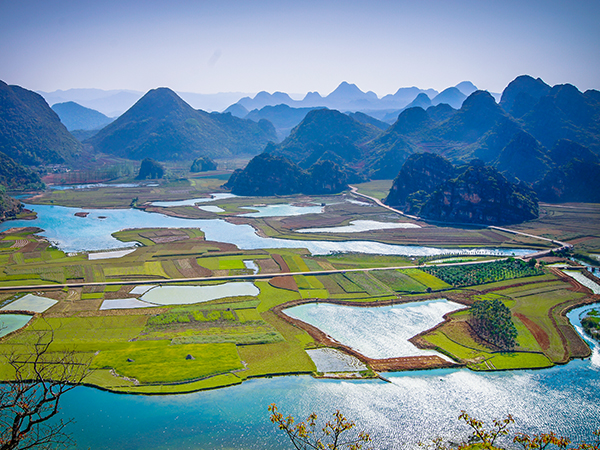
Puzhehei Scenic Area, Qiubei County, Wenshan Zhuang & Miao Autonomous Prefecture, Yunnan Province, China
A breathtaking karst landscape with lotus lakes and ethnic charm.
Puzhehei Scenic Area (普者黑风景区) is located in Qiubei County, Wenshan Prefecture, Yunnan Province. It lies just 1 km from Qiubei County, 113 km from Wenshan City, 280 km from Kunming, 85.7 km from Wenshan Yanshan Airport, and 9.8 km from Puzhehei High-Speed Railway Station. Recognized as a National 5A Tourist Attraction, it is famed for its unique plateau karst landscape of lakes, peaks, caves, and lotus fields.
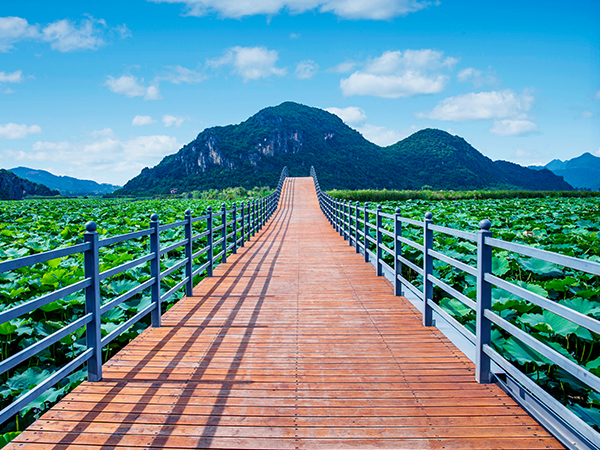
The area is home to 312 isolated peaks, 83 karst caves, 54 interconnected lakes, and more than 10,000 mu of wild lotus fields, making it one of the most breathtaking karst rural sceneries in China.
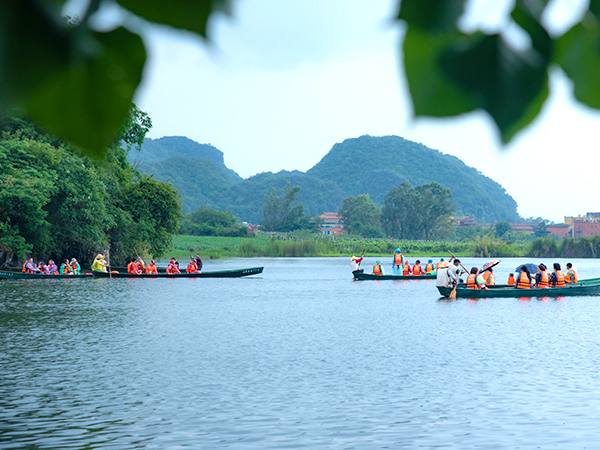
Puzhehei seamlessly blends the Yi ethnic culture with its stunning natural scenery. Villages like Xianrendong (Immortal Cave) preserve traditional Sani folk houses and fishing customs, while the Qinglong Mountain (Green Dragon Mountain) viewing platform offers breathtaking sunset views over the "lake-dotted peaks and pastoral villages." In summer, when lotus flowers are in full bloom, drifting through the lotus ponds on a Liuyezhou (Willow-Leaf Boat) is a classic experience.
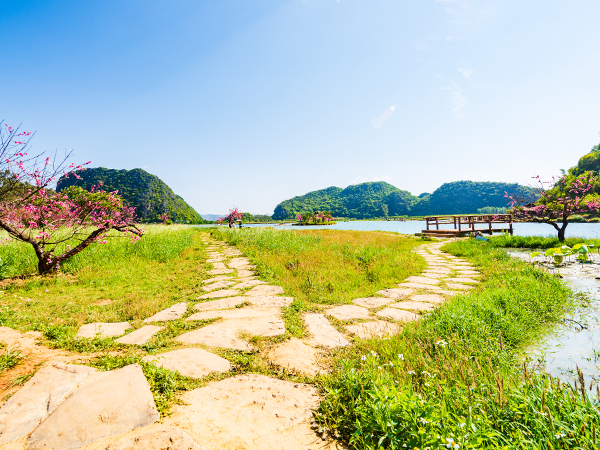
The name “Puzhehei” comes from the Yi language, meaning “a lake filled with fish and shrimp.” Covering a total area of 388 square kilometers, with a core scenic area of 15 square kilometers, Puzhehei is celebrated for six major landscapes:
It combines the elegance of Guilin's landscapes—limestone peaks, clear streams, serene caves, and peculiar rocks—with the rustic charm of Jiangnan's "small bridges, flowing water, and households," the shimmering beauty of Hangzhou's West Lake, and the grandeur of lotus marshes that surpass even the famous "Lotus Lake."
The area boasts 256 distinct scenic spots, 312 scattered isolated peaks, 83 uniquely shaped karst caves, 54 interconnected lakes, 26,667 acres of graceful wild lotus flowers, and 40,000 acres of breathtaking plateau karst wetlands. The vibrant cultures of the Zhuang, Miao, and Yi ethnic minorities add to its richness.
To summarize, the landscape of Puzhehei is categorized into five characteristics: graceful (秀), extraordinary (奇), ancient (古), pure (纯), and tranquil (幽).
Puzhehei is divided into the core area (old scenic zone) and the peripheral area (new scenic zone). The core area, which includes karst caves, vast lotus fields, and the classic landscape of mountains and fields, along with ethnic villages like Puzhehei Village and Xianrendong Village, is the main destination for most visitors. The peripheral area includes Swan Lake and wetlands, among other attractions.
Karst caves are undoubtedly a major highlight of Puzhehai. Currently, Moon Cave, Torch Cave, Guanyin Cave, and Xianren Cave are open to the public. These caves feature spectacular stalactites and stalagmites, as well as numerous mythical legends.
Located in the center of Puzhehei Lake, Qinglong Mountain is the best spot to overlook the entire scenic area. From here, visitors can enjoy a magnificent view of over 300 isolated peaks set against lakes, sea of clouds, and lotus ponds. Many classic photos of Puzhehei are taken here, making it a must-visit for photography enthusiasts and those seeking stunning sunrise or sunset views.
The mountain is not very high, rising only about 108 meters above the lake. It belongs to the low hill terrain, and visitors can reach the summit in just over ten minutes by climbing the stone steps. The mountaintop features four viewing platforms from east to west, each offering a unique perspective and serving as excellent spots for photographing sunrises and sunsets.
The mountain also houses several karst caves. Torch Cave and Moon Cave are connected, allowing visitors to enter one and exit the other. However, Moon Cave may be closed during the off-season. At the foot of the mountain, Guanyin Cave contains thousands of statues of Guanyin (the Goddess of Mercy).

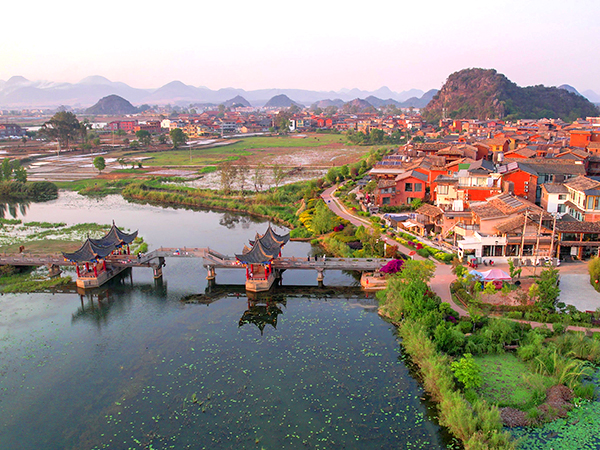
Puzhehei Village is located in the core area of the scenic spot, on the east side of Puzhehei Lake, facing Qinglong Mountain across the water. A boat ride on a Liuyezhou offers views of the "watery countryside and lake-dotted peaks." The scenery is particularly stunning from June to August when lotus flowers are in full bloom, and visitors can participate in water fights. The lotus flowers are mainly concentrated along the "Lotus Avenue" north of the village, just a five-minute walk away. The best view, however, is from a small boat navigating through the lotus clusters. Photography services are available for a fee.
The base of Qinglong Mountain also features expansive and beautiful lotus ponds. Nevertheless, the most breathtaking perspective is from the Qinglong Mountain viewing platform, where the village appears nestled among连绵的孤峰 and lotus ponds, as if embedded in a landscape painting.
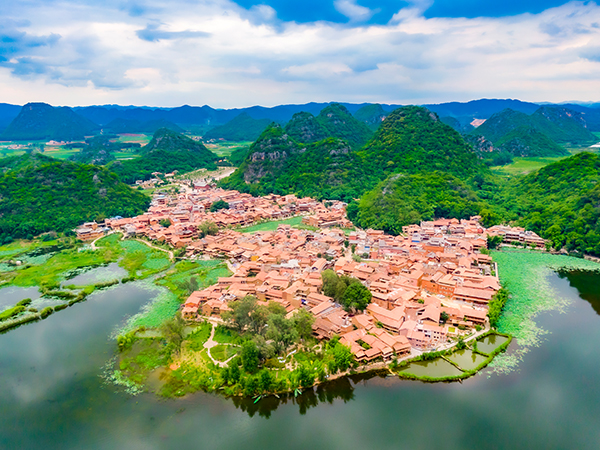
Xianrendong Village is one of the main villages in the Puzhehei Scenic Area. Developed as an Yi ethnic eco-cultural village, it features uniformly traditional houses, streets paved with bluestone slabs, and numerous inns and bars adorned with Yi decorations. Here, Yi women weaving cloth create a striking scene.
The primary karst cave attraction in the village is Xianren Cave, a pure natural karst formation. Visitors enter the cave on a small flat boat, a short two-to-three-minute ride. The walking distance inside the cave is just over one kilometer, taking about half an hour to explore.
The interior of Xianren Cave is relatively narrow, with some sections requiring visitors to squeeze through sideways. The cave is very cool and features various stalactites and stalagmites in different shapes, as well as traces of ancient human habitation. Nearby Jinsuo Mountain is also a suitable spot for watching the sunset.
Swan Lake is the most representative karst wetland and migratory bird habitat in Southwest China. On its 2.6-square-kilometer wetland, over 10,000 migratory birds of more than 100 species thrive, including swans, bar-headed geese, egrets, gray herons, spot-billed ducks, and pintails. While migratory birds are not visible in every season, the scenic area also houses artificially bred black and white swans, which are released to meet visitors four times daily.
Additionally, the lake grows 465 species of plants, including sea cabbage flowers and wild lotus flowers. Every summer, the blooming lotus flowers create a magnificent view.
The lake area is vast, allowing visitors to stroll, take an electric cart or boat, and feed the swans, offering a truly relaxing experience.
The most beautiful season in Puzhehei is from June to September, when lotus flowers are in full bloom, and visitors can enjoy boat rides and water fights. During the off-peak season, travelers can wander through the fields and villages with their cameras, capturing the authentic pastoral scenery or taking artistic photos.
The climate in Puzhehei is pleasant, with average summer temperatures (June to August) ranging from 18°C to 25°C. Daytime temperatures are cool, rarely exceeding 28°C, making it an ideal summer retreat.
The Puzhehei Scenic Area does not charge an entrance fee, but individual attractions and experiences require separate tickets. The following prices are for reference only (as of September 2025):
Boat Rides
Leaf-shaped boat: 98–200 RMB/person
Bamboo raft or painted boat: 160–260 RMB/person
Night boat ride: 398 RMB/boat
Attractions
Swan Lake: 85 RMB/person
Caves (Xianrendong, Guanyin, etc.): 15–30 RMB/person
Transportation Inside Scenic Area
Shuttle bus: 15 RMB one-way, 30 RMB round trip
Sightseeing loop bus: 92 RMB/day
Local bus (Puzhehei Station – Scenic Area): 5 RMB/person
Address: Puzhehei Scenic Area, Qiubei County, Wenshan Zhuang & Miao Autonomous Prefecture, Yunnan Province, China
Opening Hours: 8:00 AM - 6:00 PM
The most convenient way is by high-speed train. Take a high-speed train from Kunming to Puzhehei Station (travel time: about 1 hour 19 minutes). After arrival, choose from the following options:
Public Bus: Take Line 8 from the station square directly to the scenic area (5 RMB/person, operating hours: 8:00-18:30).
Taxi: About 30 minutes, costing 50-60 RMB.
From $ 264
From $ 276
From $ 333

 English