Your China & Yunnan Travel Experts

 Ask a Question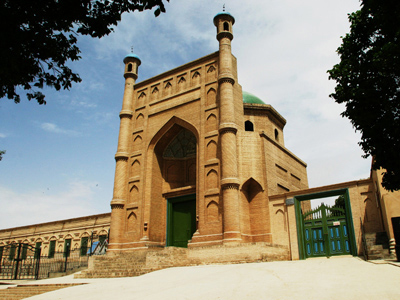
Pahata Bazaar Road, Resitan Subdistrict, Kuqa City, Aksu Prefecture, Xinjiang Uygur Autonomous Region (near the intersection of Pahata Bazaar Road and Xixi Road)
The Kuqa Grand Mosque is the second largest mosque in Xinjiang after the Itigar Mosque, and a spiritual landmark of the ancient Kucha oasis. Built in the 15th century, its existing architecture perfectly blends Islamic brick and stone art with the wooden bracket system of the Central Plains. Eighty-eight massive wooden pillars with carved beams and painted rafters support an epic tale of ethnic fusion.
This is not only a masterpiece of "Han spirit and Uyghur charm" in the eyes of architecture enthusiasts, but also a perfect place to escape the hustle and bustle and experience the pure, everyday life of southern Xinjiang. The preserved religious courthouse within the mosque bears witness to the changes in the legal system of the past, while the colorful wooden doors and the aroma of roasted naan bread in the old city outside allow you to seamlessly switch between the sacred temple and everyday life. A trip to Kuqa is to witness a cultural handshake across millennia.
 By plane
Kuqa has a small airport (Kuqa Airport), with major flights departing from Urumqi or Kashgar.
After arriving at the airport, you can take a taxi or book a shuttle to the city mosque.
 By train
You can take the Southern Xinjiang Railway to Kuqa Station, which is close to the city center. From the station, you can take a taxi or bus directly to the mosque.
By car or chartered car
Driving is convenient for tourism in Xinjiang. Road conditions in the city are good, and the Kuqa Mosque has parking, making it suitable for a half-day visit.
The historical roots of the Kuqa Grand Mosque are deeply embedded in the cultural fusion of the ancient Kucha region. Its earliest form can be traced back to the 15th century, during the Chagatai Khanate period, when Islam was deeply rooted in this oasis city on the northern edge of the Tarim Basin. As a vital commercial hub connecting the Central Plains and the Western Regions, this building in Kuqa was, from its inception, not merely a religious site, but also a center for cultural exchange and interaction among various ethnic groups along the Silk Road. While the early mosques were smaller than they are today, they have become a spiritual landmark of local society, silently witnessing Kuqa's historical transformation from an ancient Buddhist capital to a city where diverse cultures coexist through centuries of wind, sand, and war.
The magnificent structure we see today is primarily the result of a "rebirth" in the early 20th century. In 1918, a sudden fire destroyed the original ancient buildings. To continue the lineage of faith and culture, in 1923, prominent local figures raised funds and employed the best Uyghur craftsmen from across Xinjiang for a large-scale reconstruction. The craftsmen skillfully integrated Islamic brick and stone aesthetics with the dougong (bracket set) and painted techniques of Central Plains wooden architecture on the ruins, completing the project after three years. This reconstruction not only restored the physical space, but also pushed the fusion of Chinese and Western art to its peak through the 88 carved beams and painted pillars, making it a model of Qing Dynasty style architecture with great historical value still existing in southern Xinjiang.
Prayer Hall
As the central structure of the Kuche Grand Mosque, the hall covers an area of 1,165 square meters and can accommodate more than 3,000 worshippers at a time. The interior is supported by 88 massive mulberry wood columns, while the beams, ceiling, and windows are adorned with exquisitely detailed wood carvings and colorful paintings: Central Asian Islamic-style scrollwork and geometric patterns blend seamlessly with Central Plains Han-style cloud motifs and “longevity” characters, creating a palette that is both subdued and magnificent. The massive skylight at the top features a hipped roof, serving both to provide natural light and as a decorative element, while the recessed walls are adorned with calligraphic verses from the Quran. The overall atmosphere is solemn, sacred, and brimming with artistic tension, making it a living testament to the cultural fusion along the Silk Road.
Minarets (Call to Prayer Towers)
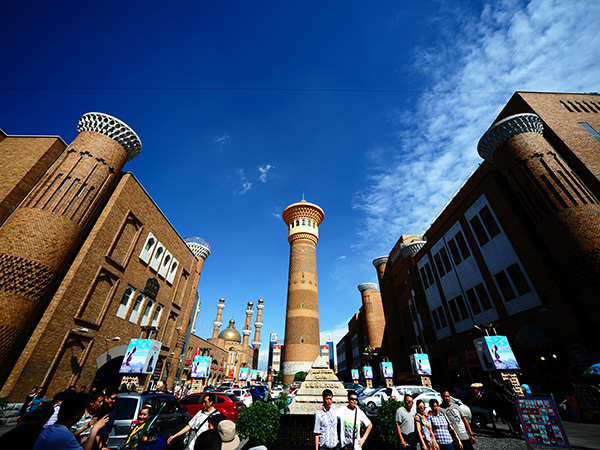
The three minarets standing on either side of the gatehouse, each approximately 16 meters tall, serve as the mosque’s most distinctive landmarks. Constructed of brick and stone, the minarets feature horizontal circular decorative bands at the joints, with surfaces carved with Islamic-style geometric and floral patterns. The tops are crowned with domed roofs and small pavilions. The minarets serve both religious and observational purposes. Historically, imams would ascend them to call the faithful to prayer. While visitors are no longer permitted to climb to the top, photographing the minarets from the courtyard or the surrounding streets—where they stand in harmony with the blue sky and nearby historic buildings—creates compositions rich in the distinctive charm of the Western Regions. Especially at sunrise and sunset, when sunlight bathes the beige brick towers in rich layers of light and shadow, these minarets become a must-visit spot for photography enthusiasts.
Courtyard and Colonnade
The central courtyard of the mosque is spacious and serene, paved with smooth bricks and stones. Several ancient trees with lush foliage provide a refreshing coolness to the courtyard. The colonnade surrounding the courtyard is supported by carved columns; the eaves and balustrades beneath the roof feature intricate openwork carvings, with patterns that continue the fusion of Central Asian and Han Chinese styles. As you stroll along the colonnade, the soft click of your footsteps on the stone slabs mingles with the rustling of leaves, while sunlight filters through the carved patterns, casting dappled shadows. Far removed from the outside world’s clamor, this space is ideal for quiet contemplation and allows you to closely examine every carved detail along the colonnade, immersing yourself in the serene atmosphere of this ancient architecture.
Ancient Steles and Cultural Relics
A dedicated area within the mosque houses a collection of precious historical artifacts, including steles from the Qing Dynasty to the Republican era, as well as hand-copied Qur’ans and Islamic texts from various dynasties. The inscriptions on the steles are written in both Uyghur and Chinese, documenting the mosque’s construction history, charitable donations, and religious regulations. These serve as primary physical sources for studying Xinjiang’s Islamic culture, ethnic relations, and local history; The handwritten scriptures, written in delicate calligraphy on parchment or rice paper, some adorned with exquisite painted borders, remain legible even after centuries. These artifacts are not merely religious relics but also precious testimonies to the cultural heritage of the Silk Road.
Surrounding Historic Districts (Restan Street / Kucha Alley)
The Restan Historic and Cultural District and Kucha Alley, located right next to the mosque, are excellent places to experience the traditional Uyghur culture of Kuche. The winding, cobblestone-paved alleys are lined with well-preserved traditional adobe dwellings, where carved wooden doors and colorful window frames create a charming contrast. Small shops selling various handicrafts line the streets, offering a dazzling array of items such as Edles silk, floral hats, copperware, and earthenware. You can also see master artisans creating these items on-site at every turn. The alleys also feature authentic Uyghur restaurants where you can savor roasted buns, Kuche-style naan, and lamb pilaf. Strolling through the area, you can not only shop for unique souvenirs but also experience the leisurely daily life of local residents, immersing yourself in the vibrant atmosphere of ancient Kucha.
From $ 521

From on request
From on request

 English