Your China & Yunnan Travel Experts

 Ask a Question
Hangzhou, Zhejiang Province, China
UNESCO World Heritage Site
The canal's story begins over 2,500 years ago, around 506 BC, during the Spring and Autumn Period in the Wu State. Its initial construction was driven by military and local economic needs. However, it was during the reign of Emperor Yangdi of the Sui Dynasty (605-610 AD) that the canal underwent a monumental transformation. In six years of furious and often brutal construction, existing sections were linked and expanded to form a cohesive national network. This colossal project was intended to consolidate imperial control, transport troops, and, most importantly, facilitate the movement of grain, silk, and other goods from the fertile south to the political and military centers in the north.
The Grand Canal's north-south orientation was strategically genius. As most of China's major rivers, like the Yangtze and Yellow River, flow from west to east, the canal acted as a crucial connector, binding together different river systems and economic regions. This infrastructure was fundamental to the economic and cultural integration of China, fueling the prosperity of subsequent dynasties, especially the Tang and Song. Suzhou, positioned strategically along this route, flourished into a paramount center of trade, silk production, and scholarly culture, its wealth and status inextricably linked to the waters flowing past its doors.
The absolute best way to appreciate the Grand Canal's magic in Suzhou is to take a boat cruise. These cruises, often on small, wooden boats accommodating around fifteen people, offer an intimate and leisurely-paced view of the city that is impossible to get from land.
A Scenic Journey:
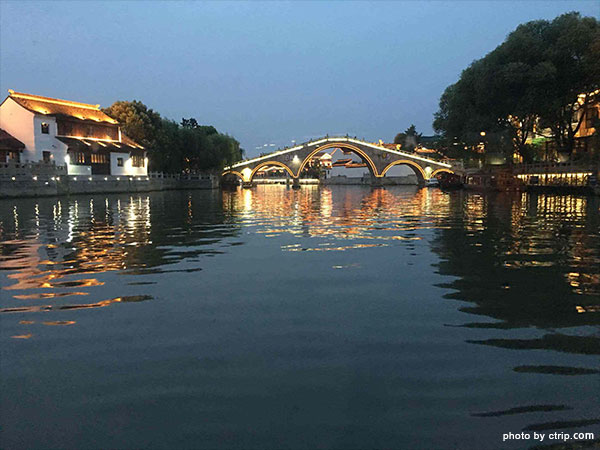
As the boat glides silently through the green-hued water, it passes under low, arched stone bridges and alongside rows of ancient whitewashed houses with characteristic black-tiled roofs. These are not reconstructed showpieces but genuine historical dwellings that have lined the canals for centuries. Each house has its own stone stairs leading directly into the water, a feature known as a "water gate." For generations, these steps have been the center of daily life—a place for washing laundry, rinsing vegetables, and children dipping their feet in the water on a hot day.
A Living Community:
The true charm of the cruise is the interaction with this living community. You will see locals relaxing on their stoops, playing cards, or chatting with neighbors across the narrow canal. It is common for them to wave and smile warmly at the passing boats, a gentle acknowledgment of the travelers sharing their historic waterway. This seamless blend of tourism and daily existence is what makes the Suzhou section of the Grand Canal so special. The area is nicely designed and maintained, with willow trees draping their branches into the water and red lanterns hanging from the eaves, creating a wonderfully peaceful and atmospheric journey.
Today, the Grand Canal is undergoing a new chapter. Beyond its historical role, it is now part of a massive national project, the South-North Water Diversion Project, where it functions as a water-diversion conduit. This modern utility underscores its enduring strategic importance. Simultaneously, significant efforts are underway to preserve and restore its cultural heritage. The UNESCO designation in 2014 has galvanized these conservation initiatives, ensuring that the canal's historical integrity is protected for future generations while it continues to serve the nation.
【Chinese name】: 京杭大运河 (Jīngháng Dà Yùnhé)
【Recommended time to stay】: The cruise itself lasts about 1 hour. Plan for a total of 1.5 to 2 hours to include waiting time and exploring the canal banks on foot before or after your ride.
【How to get there】: The most popular embarkation point for Grand Canal cruises in Suzhou is from the Shantang Street area.
Best Time to Visit: Late Afternoon to Evening: This is the most highly recommended time. You can experience the canal in the soft light of the late afternoon and then witness its transformation as the ancient houses and bridges are illuminated by glowing red lanterns after dark. The atmosphere is truly magical. Weekday mornings is a good time for a quieter experience with fewer crowds.
Practical Tips:
From $ 197
From on request

 English